News Detail
Reducing Import Dependency, BRIN Develops Titanium Alloy for Medical Implants
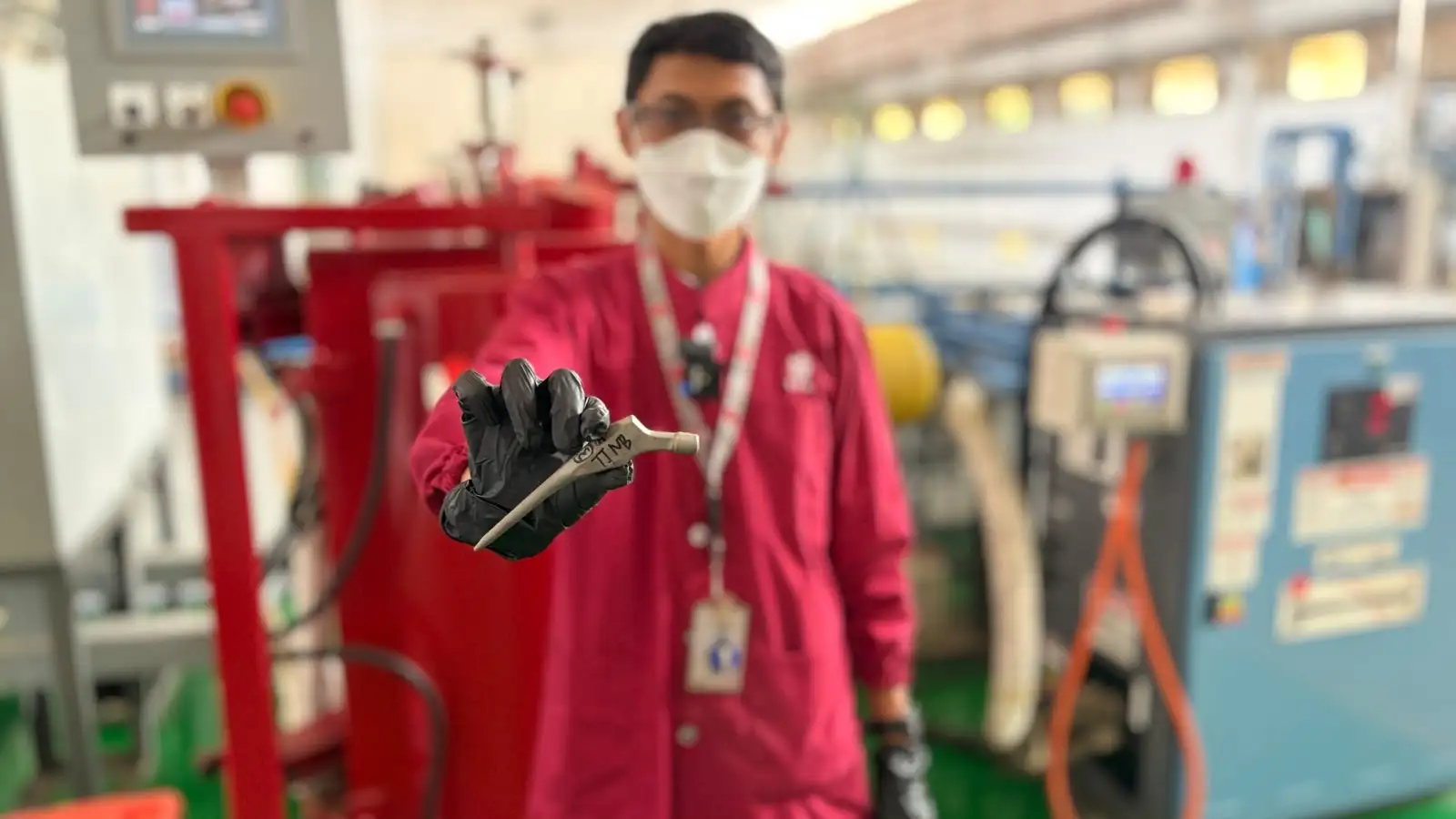
South Tangerang — BRIN Public Relations.The Research Center for Metallurgy under the National Research and Innovation Agency (BRIN) is developing titanium alloys for medical implant applications, specifically artificial hip joints. This research is part of an effort to strengthen national capabilities in producing implant materials independently while reducing dependency on imported products.
Associate Researcher at the Research Center for Metallurgy BRIN, Galih Senopati, explained that the development of titanium-based implant materials is motivated by Indonesia’s high reliance on foreign implant products. According to him, approximately 90 percent of national implant needs are still met through imports, whereas the domestic industry contributes only about 10 percent.
“Drawing from this situation, we are optimistic about independently developing titanium alloy-based implant materials so that they can be widely utilized by the public in the future,” he stated during an interview with the Public Relations Team at Building 470, B.J. Habibie Science and Technology Area (KST) Serpong, on Tuesday (6/10).
The development of titanium alloys for medical implants presents complex challenges. Titanium is well-known for its potential in biomedical applications, but its processing requires special handling because the material oxidizes easily. Therefore, the development of this material requires technological mastery, in-depth studies, as well as discussions and knowledge exchange with experts, both domestically and abroad.
In addition to mechanical property testing, implant materials must also undergo a series of tests to ensure their safety and suitability when used inside the human body. These tests include in vitro tests to evaluate cellular responses to the material, as well as in vivo tests to assess biological responses in living organisms.
The testing stages are carried out progressively in accordance with applicable requirements before the material can be used in humans and marketed. This process makes the development of implant materials longer compared to the development of materials for general industrial applications.
“For implant materials, we must ensure that they are safe to use inside the body. There are various requirements that must be met, ranging from chemical composition testing, mechanical properties, and biocompatibility, to *in vitro* and *in vivo* testing,” Galih explained.
The development of titanium-based implant materials also requires cross-disciplinary and cross-sectoral collaboration. To this end, the Research Center for Metallurgy BRIN collaborates with several research centers within BRIN, including the Center for Biomedical Research, to conduct biocompatibility testing and evaluate biological responses to the developed material.
Collaboration is also established with medical doctors as end-users who understand clinical needs, both in terms of design and the characteristics of the implant material. Furthermore, BRIN involves industry partners to ensure that the developed materials and designs can be manufactured through appropriate production processes.
According to Galih, synergy among researchers, medical professionals, and industry is a vital factor in advancing research outcomes toward utilization. Thus far, BRIN has enhanced its capabilities in independently developing and producing titanium alloys and has published its research findings in reputable scientific journals. These achievements serve as a capital to continue the development of implant materials toward potential products that can benefit the public.
“Moving forward, the development of this titanium alloy is expected to progress toward utilization and commercialization. The support of implant industry partners, particularly those located in Surabaya, presents an opportunity to drive the downstreaming process of the research results. Although it requires a long process and the fulfillment of various technical and regulatory requirements, the development of titanium-based implant materials can contribute to the independence of the national health industry,” he concluded. (adl, sm/ed: aj, MM/translator: fp)