News Detail
BRIN Urges the Public to Recognize Asteroid Threats and Planetary Defense Measures
Bandung – BRIN Public Relations. How close must an asteroid pass by Earth to be considered potentially hazardous? Distance, as it turns out, is not the sole determining factor. An asteroid's physical dimensions, structural composition, velocity, and orbital dynamics are all critical parameters that must be evaluated to assess the potential risk it may pose.
This was highlighted by Astronomy lecturer from Institut Teknologi Bandung (ITB), Budi Dermawan, during the third day of the 100 Hours of Astronomy for All event organized virtually by the Research Center for Space, National Research and Innovation Agency (BRIN), on Saturday (03/10). Budi addressed asteroid dynamics, potential impact hazards to Earth, and the diverse mitigation strategies available to counter them.
Budi explained that not all small celestial bodies in the Solar System qualify as asteroids. In astronomy, these objects fall under the broader classification of Small Solar System Bodies (SSSB), which encompasses asteroids, comets, trans-Neptunian objects (TNOs), meteoroids, and other minor planetary bodies.
Asteroids themselves can be categorized by their orbital characteristics into groups such as main-belt asteroids, Near-Earth Asteroids (NEAs), Potentially Hazardous Asteroids (PHAs), and Trojans. In the context of terrestrial impact hazards, scientific scrutiny focuses primarily on objects whose orbital trajectories bring them into close proximity with Earth's orbit.
One parameter astronomers utilize to evaluate such close approaches is the Minimum Orbital Intersection Distance (MOID), defined as the minimum distance between the orbit of an asteroid and the orbit of Earth. However, an orbital path that closely approaches Earth does not automatically render an asteroid dangerous.
Object size serves as another crucial determinant. Small-scale asteroids and those spanning tens to hundreds of meters across can yield radically different outcomes, even when passing at identical distances.
“Even if an object comes close if this intersection distance is small but the object is tiny, say one meter across, we can consider it harmless. However, if it spans up to 100 meters, that poses a genuine danger,” Budi explained.
Potential impact severity is further governed by an asteroid’s physical characteristics and orbital velocity. These parameters dictate the total kinetic energy released should an impact take place. Consequently, assessing asteroid threats demands comprehensive observational data not merely pinpointing the object's spatial coordinates, but also determining its dimensions, physical properties, velocity, and precise orbital trajectory.
Orbital mechanics also dictate that risk assessments cannot be concluded after a single flyby. Numerous asteroids undergo repeated close encounters with Earth. Gravitational perturbations during close approaches can alter an asteroid's trajectory, requiring continuous recalculation of its orbital path for subsequent encounters.
In this context, Budi introduced the astronomical concept of a gravitational keyhole. A keyhole is an exceptionally narrow corridor in space. If an asteroid passes through this precise region during a close flyby, Earth's gravitational field can tweak its orbital resonance in such a way that, on a subsequent return, the object could be placed directly onto a collision course with Earth.
This dynamic illustrates why ongoing asteroid surveillance is vital. The classification of an asteroid as potentially hazardous does not imply an inevitable terrestrial impact. Instead, continuous tracking allows astronomers to refine orbital parameters, reduce ephemeris uncertainties, and forecast subsequent close passes with higher precision.
“The earlier an object is detected, the longer the warning time available should orbital calculations indicate an impact risk. This lead time is crucial, as it dictates the viable mitigation options. The pivotal question is: what is our warning lead time? Do we have sufficient lead time?” Budi noted.
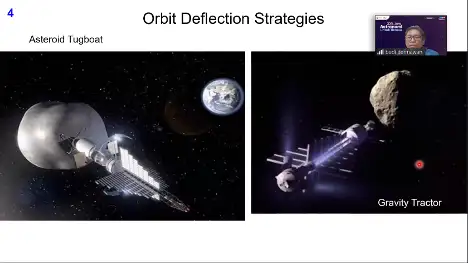
One viable mitigation strategy is orbital deflection, which involves altering an asteroid's trajectory so that it is no longer on a collision course with Earth. Budi outlined several technological concepts, including the slow push, gravity tractor, and asteroid tugboat.
These approaches do not necessarily aim to destroy the asteroid. A minor change in an asteroid's velocity or trajectory imparted well ahead of a projected impact can accumulate over time into a significant positional shift by the time the body nears Earth. Consequently, the success of planetary defense hinges decisively on how early an incoming threat is identified.
Researcher at the Research Center for Space at BRIN, Rhorom Priyatikanto, emphasized that public and scientific understanding of the space environment must be continually reinforced. This includes recognizing space phenomena that pose potential hazards to Earth.
“Feel free to use this to spark our curiosity. It should stimulate our quest for knowledge we must understand what exists around us, and recognize that threats may be lurking there,” he said.
According to Rhorom, information on space hazards should also be communicated through accessible educational media so the public can understand the nature of these threats alongside ongoing mitigation readiness. Ultimately, tracking Near-Earth Objects serves as a foundational pillar of planetary defense against asteroid hazards.
By determining an asteroid’s orbit, dimensions, physical characteristics, and encounter timeline well in advance, potential impact hazards can be objectively evaluated using rigorous scientific data and calculations. Early detection also secures the extended lead time needed to design and execute effective mitigation measures whenever required. (lcz, nna/Ed: MM/translator: ms)