News Detail
BRIN Prepares for a 200 Day Expedition, Researchers Will Explore Megathrusts and Indonesia’s Undersea Mountains
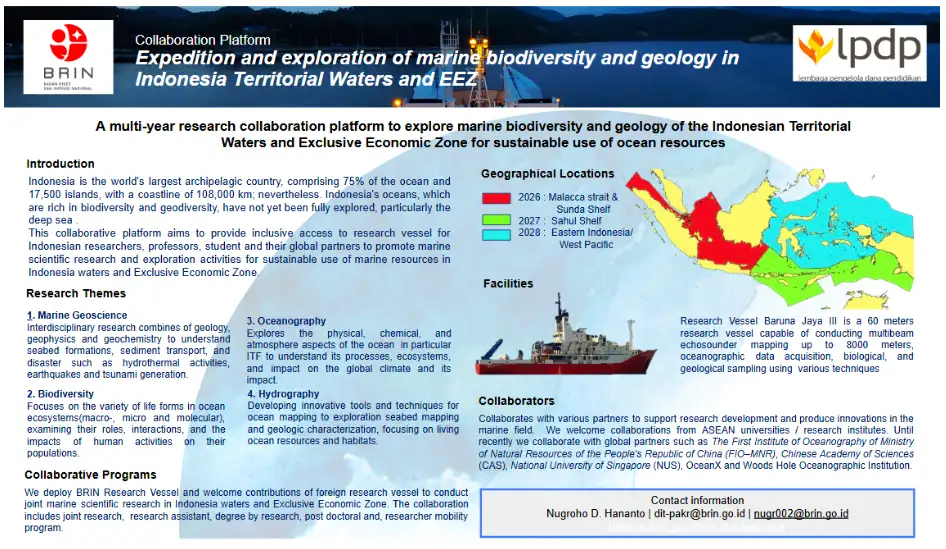
Jakarta - BRIN Public Relations. The National Research and Innovation Agency (BRIN) is planning up to 200 days at sea during the 2026–2028 period to take researchers on expeditions to explore a number of strategic areas in Indonesian waters. The expeditions will target, among other areas, megathrust zones, the Flores Thrust, undersea mountain complexes, and collision zones in eastern Indonesia to uncover potential natural resources and gather important data related to natural disasters.
This opportunity is available through the “Research and Innovation for a Prosperous Indonesia (RIIM) Strategic Invitation 2026” initiative, as part of the “Expedition and Exploration of Marine Biodiversity and Geology in Indonesian Waters” program. This program is designed to expand research in Indonesia’s maritime areas and Exclusive Economic Zone (EEZ), where adequate data is still lacking in many regions.
Head of the BRIN Research Vessel Expedition Management Team, Adi Slamet Riyadi, said that the vastness of Indonesia’s maritime territory presents both opportunities and challenges for the research community. There are still deep-sea areas, undersea mountains, subduction zones, and regions with high biodiversity that require further exploration.
“This program is designed to explore Indonesia’s maritime areas and Exclusive Economic Zone to support the sustainable use of marine resources,” Adi said at the Kick-Off Event for the RIIM Strategic Invitational 2026 in Jakarta on Thursday (20/8).
According to Adi, expeditions are necessary to collect primary data directly from the field. This information is crucial for understanding the conditions and changes in the marine environment, resource potential, and disaster risks in various Indonesian waters.
BRIN not only provides research funding, researchers also have the opportunity to use research vessels to collect data at research sites, conduct quality control and data analysis, build collaborations, and develop their research findings into scientific publications.
“Through this platform, BRIN facilitates inclusive access for researchers, faculty members, and students to collect field data, perform quality control, conduct analyses, and publish in reputable journals,” explained Adi.
In 2026, the RIIM Strategic Invitational Program will open research opportunities in four main themes: marine geosciences, biodiversity (including fisheries), oceanography, and hydrography.
The scope of the research includes the exploration of biodiversity from the ecosystem to the molecular level, fish stock assessments, marine mapping, physical and chemical processes in aquatic environments, and research on submarine geological structures.
A number of strategic areas are of particular interest, including the Flores Thrust, undersea mountain complexes, subduction zones or megathrusts, and collision zones in eastern Indonesia. These areas not only offer opportunities for scientific exploration but also hold valuable information regarding resource potential and disaster risks.
To support this research, BRIN has mobilized a fleet of vessels. The KR Baruna Jaya III will be used for hydrographic and geoscience research in the regions of Bali, East Nusa Tenggara, the Sawu Sea, and Sumba. Meanwhile, the KRI Canopus 936 will support biodiversity and hydro-oceanographic research in Natuna and the Malacca Strait. The KN Madidihang 03 has also been mobilized to support expedition activities as needed for the research.
Adi explained that BRIN hopes the data collected from each expedition will serve as the basis for further research and can also be used by ministries and agencies to support policy formulation.
One example is data on fish stocks, which can strengthen fish stock assessments in the Fisheries Management Area of The Republic of Indonesia (WPPNRI).
“What we hope for is not just the expedition itself, but that the data collected can serve as a foundation for future research and contribute to national needs,” said Adi.
The expedition also opens up opportunities for interdisciplinary and interagency collaboration. Researchers from various fields can work together to address marine issues that cannot be resolved through a single discipline alone.
Through the 2026 RIIM Strategic Invitation, BRIN encourages every research voyage to generate data, knowledge, collaboration, and findings that can continue to be utilized. With support for up to 200 days at sea, these explorations are expected to further expand knowledge of Indonesia’s maritime regions while providing a scientific basis for resource management, disaster mitigation, and national development. (bel)
The Call for Proposals for the 2026 RIIM Strategic Invitational is open from August 20 to September 6, 2026. Proposal selection will take place from September 7 to 21, followed by the announcement of selection results on September 25, 2026. The research voyages are scheduled to begin on November 5, 2026.
Further information is available in the Call for Proposals for the 2026 RIIM Strategic Invitational. (bel/ed:pur)