News Detail
Indonesia and China Strengthen Marine Research Collaboration to Address Climate Change
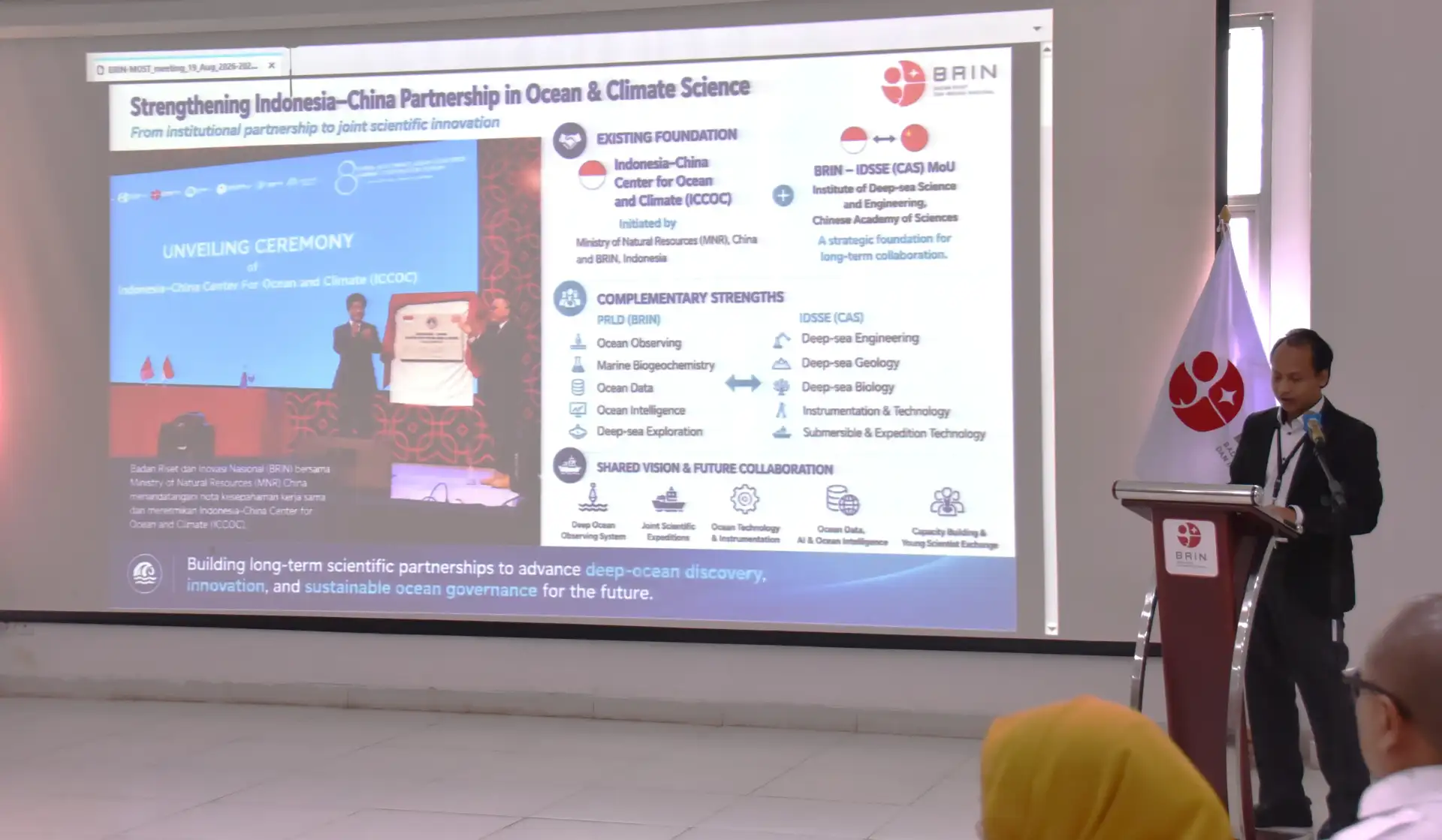
Jakarta - BRIN Public Relations. Indonesia and China strengthened their partnership in science and technology through the 8th Indonesia-China Joint Committee Meeting on Research and Innovation in Jakarta on Wednesday (19/8). Marine research is one of the areas receiving attention, particularly in addressing climate change, ecosystem degradation, and the need for sustainable management of marine resources.
Acting Head of the Research Organization for Earth Sciences and Maritime (ORKM) at BRIN, Luki Subehi, emphasized that the ocean holds a strategic position in Indonesia-China relations. According to him, the two countries not only share interests in the maritime sector but also a common vision for strengthening their capacities as maritime nations.
“The ocean not only separates the two countries but also serves as a bridge that strengthens our ties and cooperation,” said Luki.
He noted that science and technology cooperation has become an important part of the Indonesia-China comprehensive strategic partnership. One example of this is the China-Indonesia Joint Laboratory for Marine Science, established in collaboration with the Institute of Oceanology of the Chinese Academy of Sciences.
This joint laboratory serves as a platform to strengthen marine research in both countries, including in the areas of marine ecosystem protection, blue economy development, and the strengthening of marine governance. Luki hopes that the facilities and networks that have been established can evolve into a center for marine science and technology collaboration that has a broader impact at the regional level.
“Researchers from both countries can take advantage of this momentum to further deepen practical cooperation in various fields, including marine biodiversity research, marine ecosystem restoration, blue economy development, and responses to various marine challenges,” he said.
Integrating Research Capacities
Long Teng, Deputy Minister of Science and Technology of the People’s Republic of China and a member of the CPC MOST Leadership Group, stated that research cooperation between Indonesia and China has had a strong foundation for over a decade. This collaboration involves universities, research institutions, and researchers from both countries through various research programs and scientific publications.
According to Long, issues related to climate change and the oceans require a transnational approach. Therefore, the Indonesia-China scientific partnership needs to evolve from individual-level collaboration toward more integrated cooperation.
“Most importantly, we are now moving from individual-level scientific cooperation toward a more integrated and inclusive partnership,” he said.
He mentioned a number of fields with potential for joint development, such as marine and climate research, biogeochemistry, geosciences, scientific expeditions, instrumentation development, marine data management, and the application of artificial intelligence.
Indonesia, Long continued, occupies a strategic position between the Pacific and Indian Oceans. This makes Indonesia an important natural laboratory for understanding the interactions between the ocean, climate, biogeochemistry, and Earth systems.
“By combining the strengths of both countries, we can generate scientific knowledge that benefits not only Indonesia and China, but also the Indo-Pacific region and the world,” he said.
Future cooperation, according to Long, should be directed toward clear scientific objectives, the integration of infrastructure and data, increased researcher mobility, and joint programs that benefit both countries and the international community.
Strengthening Research Infrastructure
Meanwhile, A’an Johan Wahyudi, BRIN’s Head of Research Center for Deep Sea (PRLD), stated that BRIN has established several foundations for cooperation with Chinese research institutions, including through the Indonesia-China Center for Ocean and Climate (ICCOC) and various memorandums of understanding between BRIN and research institutions in China.
The collaboration covers marine, atmospheric, and climate research; marine policy; marine data; marine safety and conservation; and research supporting sustainable development.
According to A’an, these research activities are supported by BRIN’s research infrastructure, which consists of three buildings with 17 laboratories. The facilities include laboratories for marine genetics and molecular biology, marine plankton, marine biology, marine botany, ecotoxicology, microbiology, as well as various characterization and experimental facilities.
These facilities are not only used for internal research but are also open to doctoral students, postdoctoral researchers, domestic and international researchers, undergraduates, and micro, small, and medium-sized enterprises.
A’an explained that BRIN’s marine research covers five main domains, marine physical processes, marine biogeochemistry, marine resources and productivity, conservation and resilience, and marine ecosystems and pollution. The research is supported by modeling and forecasting, data analysis, laboratory research, and environmental monitoring.
“These various approaches are used to gain a better understanding of ocean conditions and the changes occurring within them,” said A’an.
The 8th Indonesia-China Joint Committee Meeting was followed by a delegation visit to the LATERIO Laboratory at the BRIN Ancol Complex in Jakarta. The visit was part of an effort to showcase Indonesia’s research infrastructure while opening opportunities to strengthen research and innovation collaboration between the two countries.
Strengthening Indonesia-China maritime cooperation is expected to yield more than just scientific publications; it is also expected to produce technology, data, and solutions to address maritime issues and climate change. The partnership between the two countries is also expected to develop into a shared scientific capacity that benefits the region and the world. (smd/doc.rbd)