News Detail
Blooming Soon, Giant Corpse Flower at Bogor Botanical Gardens Becomes Conservation Education Tool
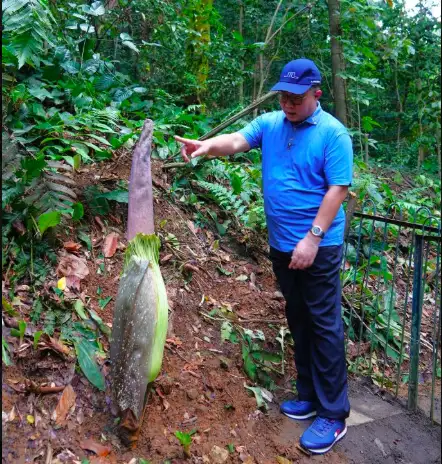
Bogor-BRIN Public Relations. The giant corpse flower Amorphophallus titanum, currently classified as Endangered, is expected to bloom fully on February 3, 2026, at the Bogor Botanical Gardens. The blooming of this giant corpse flower is a rare moment because it last bloomed in 2014.
This rare phenomenon attracted the attention of the Chairman of National Research and Innovation Agency (BRIN), Arif Satria, who visited the Bogor Botanical Garden on Saturday (1/31/2026). During the visit, the giant corpse flower had reached a height of 120 centimeters with a bud diameter of approximately 21 centimeters.
Arif explained that Amorphophallus titanum is a protected species and classified as Endangered according to the International Union for Conservation of Nature (IUCN). At the Botanical Garden itself, there are nine types of corpse flowers that have been planted since 1992.
“Well, if we look at the flowering pattern, it is still irregular, so researchers are still trying to understand how the pattern works because sometimes it blooms every 3 years, sometimes every 2 years, and the last time it bloomed was in 2014. Now, it is estimated to bloom on February 3, and this will be a very important moment for biodiversity enthusiasts in Indonesia,” said Arif during his visit.
According to Arif, this moment is important for the public to witness, especially children, so that they can learn about the rich biodiversity in Indonesia. This is because not all countries have biodiversity like Indonesia, some of which can be found in the Bogor Botanical Gardens.
"I think this is a great place to learn about plants, trees, and various rare plants. Indeed, these rare plants must also be conserved, and the Botanical Gardens are part of the government's program to conserve these rare plants," he explained.
He hopes that the Bogor Botanical Gardens will not only be a place for research and collection, but also a place for conservation education, packaged in the form of educational tourism. He believes that this can increase public awareness of the importance of biodiversity in Indonesia.
Therefore, Arif emphasized that Indonesia must prove itself as a country with rich biodiversity and good management. This way, the biodiversity in Indonesia, including that found in the Botanical Gardens, can be sustained.
“Once again, Indonesia possesses extraordinary wealth in terms of biodiversity, and this must be preserved. Our ability to protect this will greatly determine Indonesia’s position in the eyes of the world—whether Indonesia, as a nation blessed with this wealth, can nurture and manage it,” said Arif. (SBN)