News Detail
Accelerating the Development of the National Spaceport, BRIN Strengthens Cross-Sector Synergy
Jakarta – BRIN Public Relations. The National Research and Innovation Agency (BRIN) is strengthening cross-sectoral synergy to accelerate the development of the National Spaceport on Biak Island, Papua, as part of efforts to achieve independent access to space and enhance Indonesia’s global competitiveness.
These efforts are being carried out through the alignment of policies, regulations, and infrastructure readiness in collaboration with relevant ministries and institutions, local governments, defense and security elements, industry, and higher education institutions.
Deputy for Development Policy at BRIN, Anugerah Widiyanto, explained that the development of the Spaceport has a strong legal foundation. This includes Law Number 21 of 2013 on Space Activities, Presidential Regulation Number 45 of 2017 on the Space Master Plan 2016–2040, and Government Regulation Number 7 of 2023 on the Control of Space Technology, which emphasizes technology safeguard aspects.
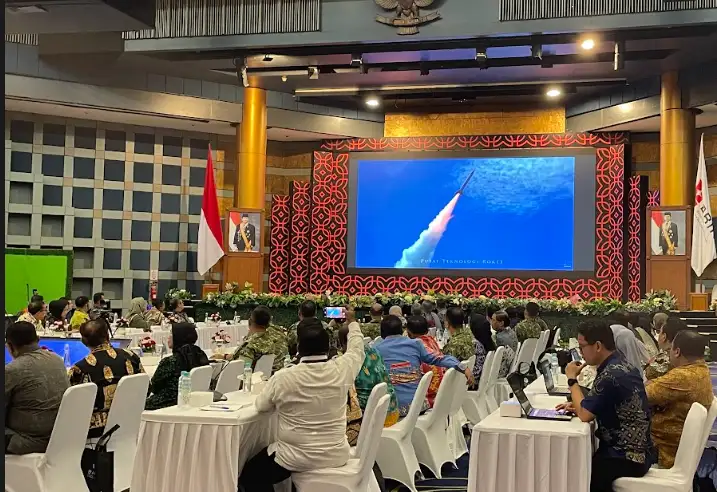
“The Draft Government Regulation (RPP) on the Operation of Spaceports has completed the harmonization process and is ready to serve as the operational basis for development. In addition, the national space master plan needs to be updated through 2045 to align with the national development vision,” said Anugerah. He conveyed this during the National Coordination Meeting (Rakornas) on the Spaceport, held at the B.J. Habibie Building, Jakarta, on Friday (19/12).
He added that studies on the development of a Spaceport in Biak have been conducted since 1990 and need to be updated in line with technological advancements, national needs, and current environmental conditions.
Biak Island has significant geographical advantages due to its proximity to the equator, which provides energy and cost efficiency for rocket launches into Low Earth Orbit (LEO). Moreover, the rapid growth of the global space economy presents a major opportunity for Indonesia to take a more active role in the launch industry and space services.
“The global space economy is estimated to account for around five percent of the world’s Gross Domestic Product (GDP). The development of a Spaceport in Biak will generate a multiplier effect for the region, ranging from job creation and economic growth to the strengthening of space diplomacy,” he explained.
During the Rakornas, the stages of the rocket launch process at BRIN were presented, starting from rocket design and manufacturing, verification of technical readiness and go or no-go decision planning, submission of NOTAM (Notice to Air Missions) and NOTMAR (Notice to Mariners) notifications for airspace and maritime clearance, public outreach, transportation of rockets and ground station equipment, rocket preparation, launch execution, and post-launch activities. All stages emphasize safety, security, and inter-agency coordination.
The development of the Spaceport also requires support from basic infrastructure, including access roads, electricity, telecommunications networks, internationally standardized healthcare facilities, as well as logistics and security systems.
From a national planning perspective, a representative of the Ministry of National Development Planning (PPN/Bappenas), Yusuf Suryanto, stated that the development of the Spaceport aligns with the direction of Papua regional development in the 2025–2029 National Medium-Term Development Plan (RPJMN) and the 2026–2045 National Long-Term Development Plan (RPJPN).
“The development of the Spaceport is closely linked to efforts to reduce unemployment, alleviate poverty, and strengthen high-quality human resources in Papua. Therefore, support for basic infrastructure and spatial planning synchronization is crucial,” said Yusuf.
He added that regulatory strengthening, technical readiness, and cross-sector integration are key prerequisites for proposing the Spaceport as a National Strategic Project (PSN).
Chairman of BRIN, Arif Satria, emphasized that the development of the Spaceport is a strategic national mandate to strengthen Indonesia’s independence in accessing outer space.
“BRIN is currently formulating derivative regulations so that after the ratification of the RPP, the designation of the site and the implementation of development can be carried out immediately, including the opening of BRIN land in Biak, which is planned to begin in 2026,” said Arif.
He stressed that the development of the Spaceport is in line with the vision of Indonesia Emas 2045, particularly in the development of the space economy, space environment, and space security, and is expected to strengthen Indonesia’s position at the global level.
Through this Rakornas, BRIN hopes to build a shared commitment among all stakeholders to realize the development of a Spaceport that is safe, sustainable, and oriented toward national interests. This development is expected not only to strengthen Indonesia’s independence in space technology but also to promote equitable development and economic growth in eastern Indonesia. (kay/ed: tnt)