News Detail
BRIN Strengthens Minapadi and Aquaponics Systems as Pillars of Sustainable Food Security
Cibinong – BRIN Public Relations. The National Research and Innovation Agency (BRIN) continues to strengthen its role in developing sustainable food systems based on research and innovation. One of the strategic approaches being promoted is the integration of agriculture and fisheries through minapadi and aquaponics systems, which are considered capable of addressing challenges related to food security, climate change, as well as limitations in land and water resources.
Head of the BRIN Research Center for Freshwater Aquaculture, Fahrurrozi, emphasized that the integration of rice and fish production has high relevance for national food security, given that rice is the staple food of the Indonesian population. According to him, rice–fish systems not only have the potential to sustainably increase rice productivity, but also add sources of animal protein while maintaining the balance of agricultural ecosystems.
He conveyed this during the International Webinar titled “Integrated Rice-Fish Farming Systems and Aquaponics: A Pathway to Enhanced Food Security and Sustainable Agri-Fisheries”, held on Monday (15/12). “The development of integrated agriculture–fisheries systems is becoming increasingly important amid the pressures of climate change and rising food demand,” Fahrurrozi explained.
In this context, research and innovation play a crucial role in ensuring food production systems that are not only productive, but also adaptive and environmentally friendly. He stressed the need for international collaboration so that research experiences and findings from various countries can mutually enrich the development of food systems in Indonesia.
In line with this, Head of the BRIN Research Organization for Agriculture and Food, Puji Lestari, stated that food security is a fundamental pillar of national development that requires availability, access, utilization, and stability of food for all communities. She highlighted the importance of innovation in food production systems that can harmoniously integrate the agriculture and fisheries sectors, considering that rice is a strategic food commodity and fish is a primary source of animal protein.
“The minapadi system involves the cultivation of fish, such as tilapia, common carp, or catfish, carried out simultaneously or alternately in rice fields. Although it has significant potential, the implementation of minapadi still faces technical and institutional challenges,” Puji explained in her remarks.
Therefore, in-depth research is needed related to optimizing planting and stocking ratios, efficient water management, as well as socio-economic analysis so that this system can be applied more broadly and sustainably.
Developments in Research on Integrated Agriculture–Fisheries Systems
Contributions from international research have also enriched the development of integrated agriculture–fisheries systems. Experience in the West African region shows that rice–fish integration can be an effective solution to increase food production while strengthening farmers’ economic resilience, although it continues to face technical and management challenges.
This was presented by Jean Fall from Cheikh Anta Diop University Dakar (UCAD), Senegal. On that occasion, he presented the results of studies on the growth performance of rice and tilapia in rice field, pond, and aquaponics systems in Senegal.
From a national research perspective, Eri Setiadi, Senior Researcher at the BRIN Research Center for Freshwater Aquaculture, explained that the minapadi system has developed in Indonesia since the late 19th century and continues to undergo innovation to this day. “Minapadi is generally divided into three main models, namely conventional, semi-intensive, and intensive, with implementation adjusted to land conditions and production objectives,” he explained.
Eri emphasized that the application of the minapadi system has proven capable of simultaneously increasing rice and fish productivity. In intensive systems, rice productivity can reach more than 11 tons per hectare, accompanied by significant fish harvest yields.
“In addition to increasing production, this system also contributes to reducing the use of chemical fertilizers by up to around 50%, improving water efficiency, and enhancing soil health and the rice field environment,” he elaborated. Thus, minapadi not only impacts yield improvement, but also the sustainability of agricultural ecosystems.
Furthermore, Eri described various technical designs of minapadi, ranging from peripheral trenches, central trenches, to combinations of in-field ponds with rice field channels. He stressed that the selection of design, fish stocking density, and water management must be adapted to land characteristics and farmers’ capacities. A research-based approach is considered essential to ensure that minapadi technology delivers optimal results without creating new environmental pressures.
In addition to minapadi, the development of aquaponics is also an important component of the sustainable food system promoted by BRIN. Aquaponics integrates fish, plants, and microorganisms within a single efficient water recirculation system, making it particularly relevant for areas with limited land and water availability, including peri-urban and urban regions. This system enables the simultaneous production of fish and vegetables with significantly lower water use compared to conventional systems.
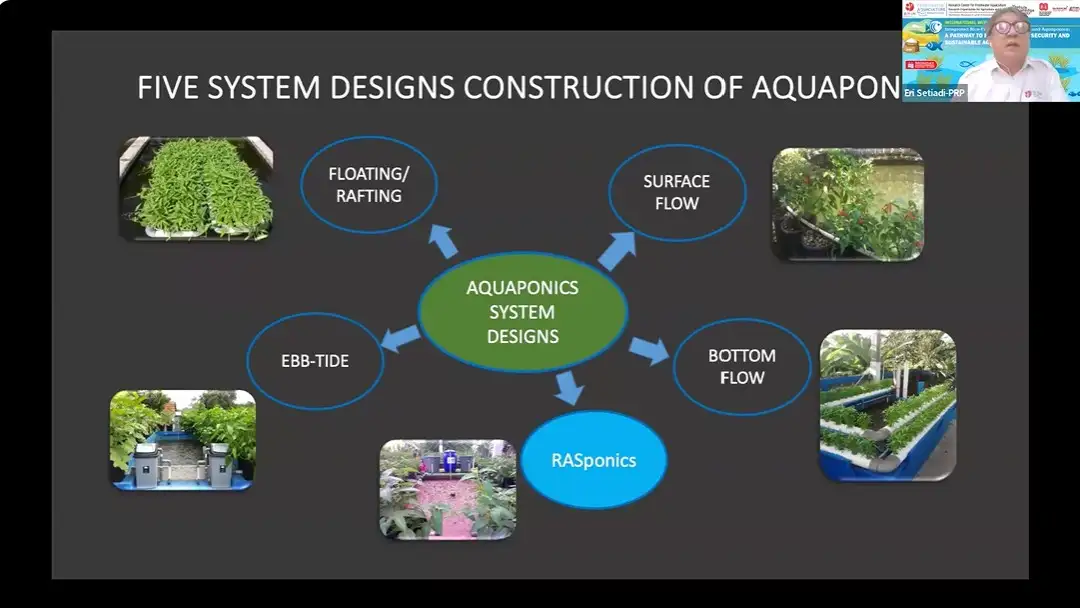
Various aquaponics models have been developed in Indonesia, ranging from surface flow, bottom flow or nutrient film technique, ebb-tide, to RASponic systems that combine recirculating aquaculture systems with hydroponics. Several of these models demonstrate the potential for fish and vegetable production within relatively short periods and with high resource efficiency, thereby opening opportunities for the development of integrated, technology-based food enterprises.
Through the strengthening of research and knowledge dissemination, BRIN hopes that minapadi and aquaponics systems can serve as important references in policy development, further research, and the implementation of sustainable food technologies across various regions. Strengthening research-based food systems is expected to support the realization of resilient, sustainable, and inclusive national food security. (aa/ed: ade, mfs)