News Detail
Supporting the 6G Era, BRIN Develops High-Speed Communication Technology
Bandung – BRIN Public Relations. National Research and Innovation Agency (BRIN) is developing optical-based sub-terahertz technology and smart cloud network implementation to support the deployment of 6G.
Ken Paramayudha, Researcher at the Research Center for Telecommunication Technology BRIN, conveyed research on the development of optical-based sub-terahertz devices for beyond 5G telecommunications technology. He explained that the sub-terahertz spectrum is one of the main candidates for high-speed communication in the 6G era.
“Telecommunication technology will continue to advance and shift toward 6G, where data speed requirements may reach up to one hundred times faster than 5G,” said Ken during the PRT #6 webinar, themed “Key Technologies for Beyond 5G: Innovation in Sub-THz Spectrum and Distributed Network Architecture”, Thursday (27/11).
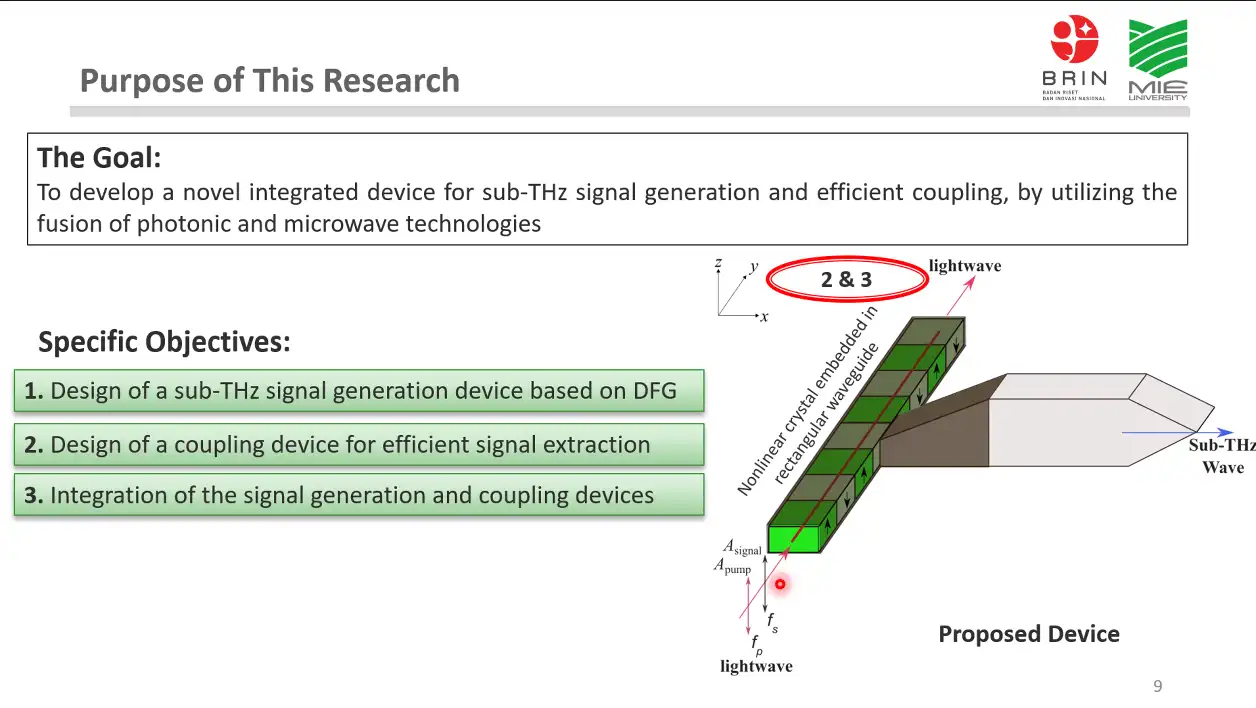
Ken emphasized the challenges in designing devices capable of generating sub-terahertz signals effectively and sustainably. One of the approaches used is difference frequency generation (DFG) by utilizing nonlinear optical materials integrated into a rectangular waveguide.
“This method is capable of generating a continuous wave signal and operating at room temperature,” explained Ken.
The research results show the device is able to produce signals up to 100 GHz. This result is considered an important initial step toward implementing sub-terahertz frequencies in future communication systems. Through a resonance-based design approach and CST simulation, Ken demonstrated that integrating photonic and microwave technologies can improve signal amplification efficiency.
“This device can be applied for high-speed optical–electrical conversion and fiber optic–based radio transmitters,” he stated.
The development of sub-terahertz technology and smart cloud networks are two crucial elements toward full implementation of 6G. “Material innovation and system integration are essential in developing next-generation telecommunication devices,” he stressed.
Meanwhile, Arief Indra Irawan, PhD student at Okayama University, discussed a privacy processing approach in service function chaining (SFC) in multi-domain virtual networking as part of strategies toward intelligent cloud communication in 6G.
“Network virtualization technology is now a key foundation for telecommunication system efficiency. With virtual networks, infrastructure becomes more flexible because each service can be arranged according to application needs,” said Arief.
He explained that applying deep reinforcement learning (DRL) in network function placement enables autonomous and adaptive decision-making.
“This is important, as 6G demands full-dimensional multi-access connectivity integrating land, air, and satellite systems. Network decisions must be intelligent, because DRL can carry out long-term optimization based on the operational environment,” Arief stated. (da/ed: nu, tnt)