News Detail
West Kalimantan Kratom: A Natural Commodity with Industrial and Health Value
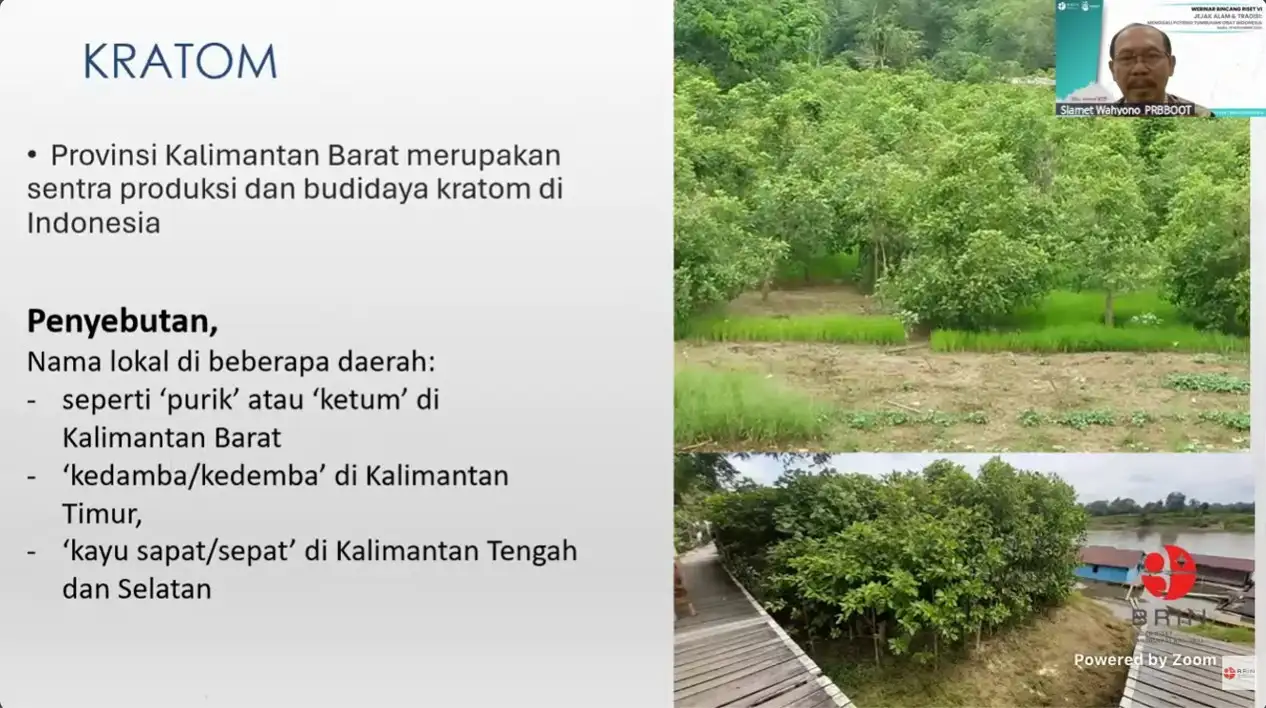
Cibinong - BRIN Public Relations. Slamet Wahyono, a Senior Researcher at the Research Center for Pharmaceutical Ingredients and Traditional Medicine OR Health BRIN, explained the utilization of kratom in Kapuas Ulu, West Kalimantan, as one of the kratom production centers in Indonesia. Besides being an ecological commodity and used for house interior walls, kratom leaves are also used in traditional medicine.
"Kratom is also one of the plantation products in West Kalimantan that has successfully shifted interest from other plantation products, such as rubber. The kratom plant itself has ecological commodity characteristics, which we can use to prevent river abrasion," he added during a webinar titled 'Traces of Nature and Tradition: Exploring the Potential of Medicinal Plants from Indonesia,' on Wednesday (11/19).
He explained that kratom is also used to prevent the greenhouse effect because, besides the fact that the plant can grow along riverbanks in water, the development or growth of leaves or leaf regeneration is quite fast and dense for a single plant. In addition, because it can be planted in forests, it will create opportunities for jobs by being harvested as one of the non-timber forest products.
Kratom is also easy to cultivate, with two methods according to market demand, either dried directly or fermented. There are also some who already have sufficient capital and make powder using machines.
"The social benefits can also be seen from that side, because the value of kratom is quite high, it will create job opportunities, especially in Kapuas Hulu, West Kalimantan. Planting, harvesting, and post-harvest processes are carried out by the local people or farmers themselves, so it provides a lot of employment opportunities," he explained.
With these impacts, he continued, farmers will earn income, which will reduce school dropout rates that are usually hindered by lack of income. Furthermore, it will certainly affect the reduction of crime as well, since people will be busy farming.
“Another impact is that with sufficient harvests, it is possible to send children to school outside the district. In Kapuas Hulu Regency, higher education often requires going to another city,” he said.
Slamet revealed that the empirical use of kratom as a traditional medicine was found from Ristoja data, particularly in 2015. Kratom was also found among the Galumpang ethnic group in West Sulawesi to treat diarrhea and skin diseases, as well as among the Bencian ethnic group in East Kalimantan for facial smoothing.
“In Kutai, East Kalimantan, it is used for childbirth care, and in Berau, North Kalimantan, it is also used for muscle aches, fatigue, and to stimulate menstruation. This is aside from West Kalimantan, so several regions also report that kratom or kratom leaves are used as a traditional medicinal preparation,” he explained.
Irwan Effendi, Head of the Aketajawe Lolobata National Park (TNAL), presented material titled The Potential of Medicinal Plants and Bioprospecting Based on the Traditional Knowledge of the O'Hongana Manyawa Tribe (Tobelo Dalam).
“TNAL is an area with intact ecosystems, high biodiversity, and is home to the O’Hongana Manyawa or Tobelo Dalam Tribe, who have extensive knowledge regarding the use of medicinal plants. From the TNAL area, 38 types of medicinal plants from 24 families were found, with 21 healing properties, including six types used for postpartum care,” he emphasized.
According to him, several plants commonly used by the community come from the families Euphorbiaceae and Zingiberaceae. To explore their potential further, TNAL, together with the BRIN Biological and Environmental Research Organization, conducted scientific studies on four main medicinal plants, namely Togutil Root (Fibraurea sp.), Yellow Root (Arcangelisia flava), Ant Nest (Myrmecodia sp.), and Galoba (Alpinia nutans).
“We have included these four types of plants in our program implementation plan as a follow-up to the cooperation with ORHL BRIN. For 2025, the focus is on Togutil Root in February. Then in 2026, it will be Yellow Root, 2027 Ant Nest, and in 2028, Galoba,” he concluded.
At the end of his presentation, he emphasized that in this cooperation, they share roles: the exploration and collection of plant species is carried out by the TNAL Center. "Meanwhile, the identification and molecular identification of the active compounds will be carried out by colleagues in the BRIN laboratory through ORHL," he concluded.