News Detail
BRIN Develops Magnesium-Based Bone Implants
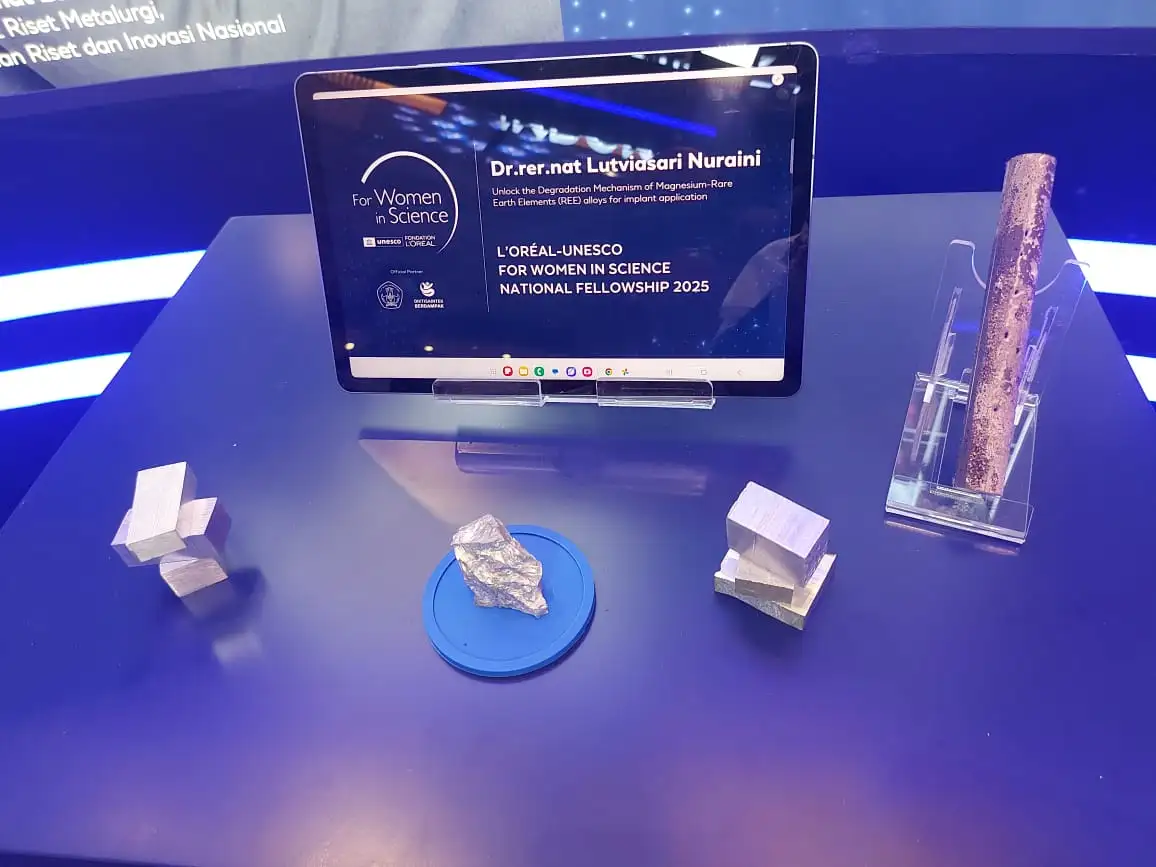
Jakarta - BRIN Public Relations. Junior Expert Researcher at the Research Center for Metallurgy, National Research and Innovation Agency (BRIN), Lutviasari Nuraini, is developing bone implant materials based on magnesium (Mg) alloys as a safer alternative to orthopedic implants that do not require removal surgery. This research is considered to have the potential to support national independence in medical devices in the field of orthopedics, especially since magnesium casting technology in Indonesia is still very limited.
Lutviasari explained that the bone implants currently in use are generally made of stainless steel (SS), titanium (Ti), and cobalt-chromium (Co-Cr), which are permanent and have stiffness far above that of human bones. This can trigger stress shielding, which is the weakening of the bone around the implant due to uneven load distribution. In addition, patients also have to undergo a second surgery to remove the implant after the bone has healed.
"In many countries, implant research is beginning to focus on materials that can be broken down in the body or are biodegradable. Magnesium has become one of the strong candidates due to its mechanical properties being similar to bone and its ability to be absorbed by the body after degradation," he said, in an interview with BRIN Public Relations on Friday (11/14).
Magnesium has a density and elastic modulus relatively close to human bone. When degraded, magnesium turns into Mg²⁺ ions that can naturally be absorbed by the body, eliminating the need for patients to undergo additional surgery. However, pure magnesium has the drawback of a corrosion rate that is too fast and the formation of hydrogen gas during the degradation process.
To address this, Lutviasari and her team developed a magnesium–zinc–neodymium (Mg–Zn–Nd) alloy. The addition of zinc aims to strengthen the material's structure, while neodymium serves to improve the microstructure and corrosion resistance. Neodymium is also one of the rare earth metals available in Indonesia, so its use can support the utilization of local resources.
"We want to obtain an alloy with a degradation rate that matches the bone healing time. So, the implant remains strong enough to support the tissue, then gradually degrades without causing complications," she said.
Magnesium casting technology is still limited
One of the biggest challenges in developing magnesium-based implants is the metal casting process. Liquid magnesium is highly reactive, easily oxidized, and can cause fires if exposed to moist air or water splashes. Therefore, the magnesium casting industry in Indonesia is almost nonexistent, and many previous studies have been carried out through collaboration with institutions abroad.
"High safety measures and extra careful handling are required in magnesium casting. Fine magnesium powder or molten vapor can easily catch fire when reacting with oxygen or water vapor in the air. For that reason, every time we perform casting, we have to consider the safety of the process," said Lutviasari.
This year, the BRIN Research Center for Metallurgy team formed a special working group to develop the magnesium casting process. Magnesium–zinc casting trials have been successfully conducted in the BRIN laboratory and serve as the basis for the next stage in the development of magnesium–zinc–neodymium alloys.
In addition to the casting stage, the material must also undergo further processes such as heat treatment to improve grain size and phase distribution, as well as mechanical processes like rolling to enhance its mechanical properties. All of these stages are necessary before the material can be further processed into orthopedic implant forms, such as plates or screws.
Corrosion and biological testing
After the manufacturing process, the magnesium alloy is tested in a body simulation solution at a temperature of 37 degrees Celsius and a pH of 7.4. The testing is carried out using the hydrogen evolution method to measure the volume of hydrogen gas produced, as well as electrochemical tests such as potential dynamic polarization (PDP) and electrochemical impedance spectroscopy (EIS).
From the immersion results, Lutviasari and the team observed corrosion products on the surface and cross-section to understand the material degradation mechanism. This information is needed to ensure that the alloy's degradation rate meets clinical requirements.
In addition to corrosion testing, this research also collaborates with the Research Center for Pharmaceutical Ingredients and Traditional Medicine at BRIN to conduct antibacterial tests and cytotoxicity tests. "We want to ensure this material is safe at the cellular level before moving on to further testing," she said.
Towards the self-reliance of national implants
According to Lutviasari, efforts to develop this alloy implant cannot be separated from the national need for medical devices. Most orthopedic implants are still imported, partly due to the limited domestic production capabilities of basic materials. By mastering magnesium casting and processing technology, Indonesia has the opportunity to develop more self-sufficient implant products.
Currently, the form of the produced material is still in the form of ingots or cylindrical rods resulting from casting. In the future, once the alloy composition and characteristics are stable, the team aims to create prototypes such as screws or plates, as well as further testing on test animals before moving towards the clinical validation process.
“The hope is that this research can be an initial step so that we are not always dependent on imported implants. If we can master the underlying technology, the domestic industry can also get involved,” she said.
Several countries such as Germany, South Korea, and some European countries are known to have developed magnesium implants to the commercial stage. However, the metal alloys used vary, depending on each country's strategy. The development of Mg–Zn–Nd alloys at BRIN is expected to provide a relevant alternative considering Indonesia's conditions and mineral resources.
In addition to focusing on casting processes and material testing, Lutviasari is also exploring collaboration with various research centers at BRIN as well as external institutions, including in the medical field. She mentioned that this long-term research aligns with efforts to build a research ecosystem up to product downstreaming.
"We are indeed still at an early stage. But if all steps, from processing, characterization, corrosion testing, to biological testing, can be mastered, the opportunity to produce magnesium implants from Indonesia will be even greater," she said.
With ongoing research, this magnesium-based implant innovation is expected to become one of the important steps towards technological self-sufficiency in medical devices in the country.