News Detail
BRIN and SIG Develop Environmentally Friendly Green Concrete Materials
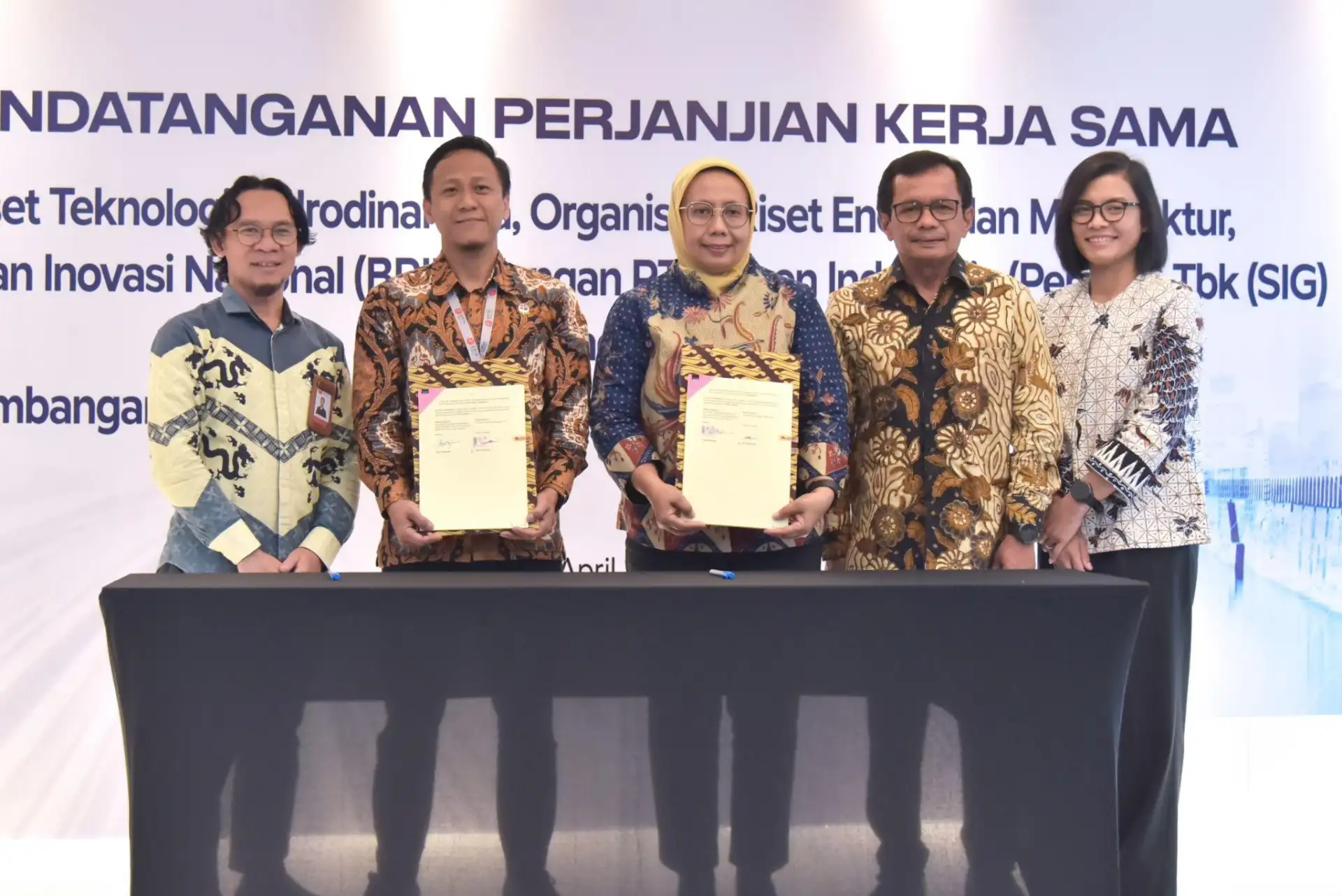
Jakarta-BRIN Public Relations, The National Research and Innovation Agency (BRIN) has officially established a partnership with PT. Semen Indonesia (Persero) Tbk (SIG) to develop environmentally friendly concrete materials, specifically designed for infrastructure in coastal and marine areas.
"The green concrete that will be developed targets energy efficiency, low carbon emissions, and maintains high structural quality. We are optimistic that the results of this collaboration will be a significant contribution to achieving Indonesia's net zero emission target," said the Chairman of the Research Organization for Energy and Manufacture of BRIN, Cuk Supriyadi Ali Nandar.
This collaboration was realized with the signing of the Cooperation Agreement (PKS) at the Signature Lounge, The East Building, Jakarta, Wednesday (30/4).
Cuk Supriyadi welcomed this collaboration as a form of real synergy between the world of research and industry. According to him, this collaboration is very important because research is carried out based on the real needs of industrial partners.
The Head of the Research Center for Hydrodynamics Technology, Teguh Muttaqie, continued that the development of green concrete will focus on the use of non-conventional alternative materials and industrial waste, such as nickel slag. The resulting concrete composition is designed to meet the challenges of extreme environments in coastal and marine areas. Including port infrastructure, embankments, and other strategic areas.
"We will develop a new formulation in concrete composition that is not only low carbon, but also supports the principle of circular economy by utilizing industrial waste as a mixture. This green concrete will be a real form of BRIN's contribution to low-emission development in the infrastructure sector," as Teguh said.
President Director of PT. SIG, Donny Arsal emphasized that the collaboration is part of the company's long-term strategy in presenting product innovations, which have added value and high competitiveness in an increasingly competitive market.
The cement industry, according to Donny, is no longer sufficient to rely on conventional products. By developing green cement, more environmentally friendly cement will be produced in terms of raw materials and production processes.
For this reason, his party continues to transform to answer future challenges. "We have reduced production emissions by 38%, from 800 kg to 500 kg of CO₂ per ton. Through this collaboration, we are committed to maintaining this trend so that it continues," as Donny said.
Director for Operations of PT. SIG, Reni Wulandari, added that as an industrial partner, her party emphasized that this innovation is part of the company's roadmap. This is in creating sustainable construction solutions, especially in coastal areas facing the challenges of climate change.
"By developing green concrete products for the marine infrastructure area, we are not only answering the specific needs of coastal infrastructure, but also contributing to efforts to reduce greenhouse gas emissions globally," as Reni said.
This product is expected to be widely adopted to answer the challenges of urbanization, climate change, and Indonesia's geographical risks as an archipelagic country.
This collaboration not only produces innovative products, but is also directed at creating joint intellectual property that can strengthen the national technology portfolio. With the synergy of both parties, it is hoped that the results of this research will be able to encourage the use of environmentally friendly technology more widely in national development projects. (pau/ed:and, tnt/translator:akb)