News Detail
The Potential of Used Cooking Oil for a the Future of Clean Energy
South Tangerang-BRIN Public Relations, Used cooking oil is a high-value waste if managed properly. As a raw material for Sustainable Aviation Fuel (SAF), used cooking oil can contribute to the transition towards green energy and open up economic opportunities, both locally and globally.
This was conveyed by several speakers from the Postdoctoral program at the Research Center for Sustainable Production System and Life Cycle Assessment (PRSPBPDH) of the National Research and Innovation Agency (BRIN), as well as from outside BRIN, during a Focus Group Discussion (FGD) with the theme 'Sustainable Used Cooking Oil Supply Chain for Sustainable Aviation Fuel (SAF): Technological Innovation, Social Synergy, and LCA Analysis', both in-person and online on Wednesday (16/04).
Postdoctoral researcher at PRSPBPDH BRIN from 2023-2025, Arif Rahman presented on the importance of sustainability in SAF production to reduce greenhouse gas emissions, decrease dependence on fossil fuels, promote a circular economy, reduce local air pollution, support sustainable development, and meet regulations and market demands.
Arif stated that the global aviation industry has set a target for carbon neutrality by 2050, amounting to 21,2 gigatons. One of the strategies undertaken to achieve this target is to switch from fossil fuels, namely jet fuel, to more environmentally friendly and renewable fuels developed through Sustainable Aviation Fuel (SAF).
One of the strategies undertaken to achieve this target is to switch from fossil fuels, namely jet fuel, to more environmentally friendly and renewable fuels developed through Sustainable Aviation Fuel (SAF). "The results of the Life Cycle Assessment (LCA) study provide a scientific basis for decision-making regarding policy development, investment, and technological innovation in the effective production of SAF towards a more environmentally friendly future," said Arif.
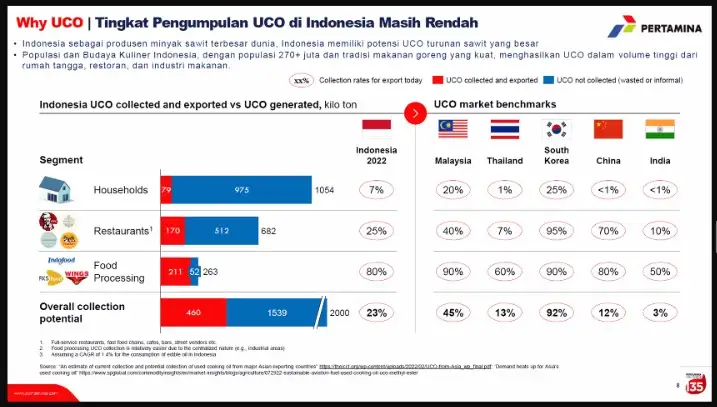
On that occasion, Philippe Micone from PT Noovoleum Indonesia Investama provided a case study example of the used cooking oil collection box branded Pertamina, which is an initiative from Pertamina Patra Niaga and started on December 21 of last year. Currently, the initiative has been successfully implemented in nine locations, with a target of reaching 300 locations by the end of this year.
In line with this, Sigit Setiawan from PT Pertamina Patra Niaga stated that Pertamina already has established facilities and infrastructure throughout the entire business value chain, each of which will play a role in the development of sustainable aviation fuel (SAF) business.
"Certification is needed for each type and stage, starting from the upstream side, which is the collection of used cooking oil by companies or businesses, the processing stage at the refinery, to the distribution, storage, and sales stages handled by Pertamina Patra Niaga, which need to be complemented with the International Sustainability and Carbon Certification (ISCC)." This is necessary as a form of responsibility for the emissions produced," he explained.
Next, Matias Tumanggor from the Used Cooking Oil Collectors Association (APJETI) hopes for price regulations from the government so that there is a price determination for used cooking oil collectors directly to the producers. "Because there is no regulation yet, we are often threatened by field officers who always accuse us of abuse," he added.
Another speaker, Setiady Goenawan from the Indonesian Used Cooking Oil Exporters Association (AEMJI), stated that SIMIJEL has collaborated with Veriflux to ensure that the traceability data stored is synchronized and recognized by the European Union's Environmental Protection Agency (EPA). AEMJI itself has supported the export of used cooking oil for 17 years to various countries such as those in Europe, Malaysia, Singapore, South Korea, and the United States. (dsl/ed:jh, aps/translator:akb)