News Detail
BRIN Studies the Impact of MUI's Fatwa on the Boycott of Israel-Affiliated Products
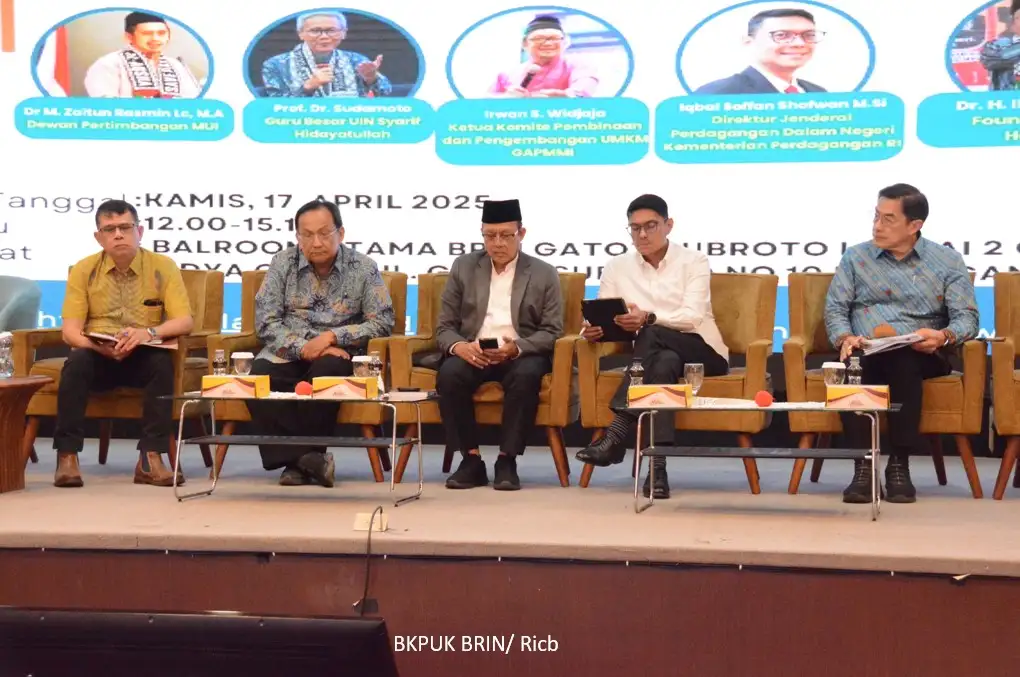
Jakarta-BRIN Public Relations, The emergence of Indonesian people's boycott actions to avoid transactions and use of products affiliated with Israel was partly driven by the new fatwa of the Indonesian Ulema Council (MUI) number 83 of 2023.
Related to this, the National Research and Innovation Agency (BRIN) through the Research Center for Religion and Belief (PRAK) conducted research to analyze the perception of the Indonesian people towards the fatwa and its impact on the national industry.
BRIN together with the Indonesian halal advocacy institution, namely Indonesia Halal Watch (IHW) held a focus group discussion that presented various institutions, academics, and organizations, on Thursday (17/04) at the BRIN Campus, Sarwono Prawirohardjo Science Area, Jakarta.
The Head of PRAK BRIN, Aji Sofanuddin said that this forum was to explore views and experiences related to the MUI fatwa, especially its impact on the growth of the national industry.
This was emphasized by the Chairman of IHW, Joni Arman Hamid who hoped that various dimensions of the implementation of the fatwa would be explored. Including public perception of the urgency of product boycotts, possible economic impacts, and the potential for strengthening regulations to support these strategic steps.
"This collaboration has added value in the context of international diplomacy that shows a strong commitment to the MUI fatwa. Thus, this research can identify the main obstacles faced by the community and business actors in complying with the fatwa, and formulate strategic recommendations that can increase the effectiveness of its implementation," he explained.
On that occasion, PRAK BRIN Researcher, Fauziah, said that her party conducted research covering 13 regions, namely Bandung City, Cirebon City, Cirebon Regency, Kuningan Regency, Majalengka Regency, Bogor City, Depok City, DKI Jakarta, Surabaya City, Serang City, Tangerang City, South Tangerang City, and Bekasi City.
From the results of her research, Fauziah said that the MUI fatwa on the product boycott had formed a change in attitudes in society in terms of their consumption patterns, both food, drinks, and household needs.
"It turns out that this fatwa is accepted as a product of religious law, but also as a socio-economic movement that has a strategic impact. Thus, this fatwa functions as a tool for moral and economic mobilization, and also encourages the growth of the national industry," she explained.
In the discussion, Handaka, as Deputy Chairperson of the Restaurant Sector of the Indonesian Hotel and Restaurant Association (PHRI)) expressed his aspirations on behalf of local entrepreneurs who want to continue developing their businesses.
"Because we, the entrepreneurs, really want to grow, PHRI is ready to have a dialogue with BRIN and MUI to produce a credible affiliated list so that no one is harmed," he said.
He expressed his hope that more in-depth research would be carried out and a list of products that are truly affiliated and those that are not.
Meanwhile, Sudarnoto, as a Professor at UIN Syarif Hidayatullah Jakarta, is of the opinion that the Palestinian issue is not just a Hamas and Israel issue, not just a matter of Middle Eastern countries, but has become a global humanitarian issue that must receive attention from all elements of society.
"The government needs to protect the community and the market, so that the market and economy can be stable, not disturbed by issues that are unclear," he said. According to him, government involvement with the MUI and various institutions needs to be done.
"When Mr. Prabowo mentioned evacuation, I agreed! However, I reject relocation," he added. Therefore, Sudarnoto suggested that President Prabowo's decision on the evacuation should be studied more deeply, so as not to cause chaos and controversy in the community.
On the same occasion, Iqbal Soffan Shafwan from the Directorate General of Domestic Trade - Ministry of Trade of the Republic of Indonesia revealed that there are no products in the Fast Moving Consumer Goods (FMCG) category, for example fruits, clothing, other daily consumption products imported from Israel. "Because we do not have diplomatic relations with Israel," said Iqbal. Therefore, he suggested being more assertive in defining and determining what products are affiliated with Israel.
"For example, is there any involvement of ownership elements from parties who have indeed contributed fully to Israel or not. Then, this is reinforced in the legal basis in Indonesia. In the foreign political situation, in the law, it is stated that Indonesia firmly rejects all forms of colonialism because it is contrary to humanity and justice," as explained by Iqbal.
In terms of economic growth, the Ministry of Trade can convey data that in the 2023-2024 Macroeconomic Statistics, the value of household consumption in the fourth quarter of 2023 did indeed fall compared to the previous quarter, namely to 4,83%. However, it then rose again in the first quarter of 2024 and was stable until the fourth quarter (4,91% - 4,98%).
In detail, in 2024 there was a growth in business fields in the accommodation, food, and beverage sector of 8,56%. This means that this sector continues to grow and contribute to Gross Domestic Product (GDP).
"In 2024, the FMCG market value in Indonesia grew by 7%, then the market size of catering services (food and beverage providers) in Indonesia continued to experience growth of 13% per year," he added.
Iqbal explained that there are many factors that cause people to switch to domestic products. "Maybe one of the factors is the MUI fatwa, but it could also be the trend of changing economic concepts of young people who are not influenced by international brands," he explained.
Furthermore, M. Zaitun Rasmin, as the MUI Advisory Council, gave his support so that the spirit of the ulama must be encouraged in voicing the truth. "While the implementation can be handed over to stakeholders and competent people, because the principle is to respect and appreciate each other," he added.
Irwan S. Wijaya, Chair of the GAPMMI MSME Development and Development Committee, said that he thought that food and beverages were indeed the most impactful. He said that indirectly this fatwa actually revived Indonesian MSMEs. Because, as a result, there was a change in consumer patterns, namely from buying international products to switching to national products.
His party also wanted consumers not to accept too many imported goods, because according to him local products were better.
"We are pursuing economic growth where we need new entrepreneurs. The food and beverage business itself is now growing. People's purchasing power automatically grows. The food and beverage industry is growing and creating jobs because it is labor-intensive," he explained.
From this discussion, it is hoped that the government and MUI can expand education and literacy related to affiliated products so as not to cause disinformation. "Of course, there also needs to be an evaluation, from the trends in public awareness whether it continues or not. So, this requires cross-religious collaboration because of the basis of humanity," as concluded by Fauziah. (amn/ ed: And, aps/translator:akb)