IDEN
News Detail
Reduce Carbon Emissions, BRIN - PT ASI Develops Microalgae-Based CCUS Photobioreactor
Published on March 10, 2025
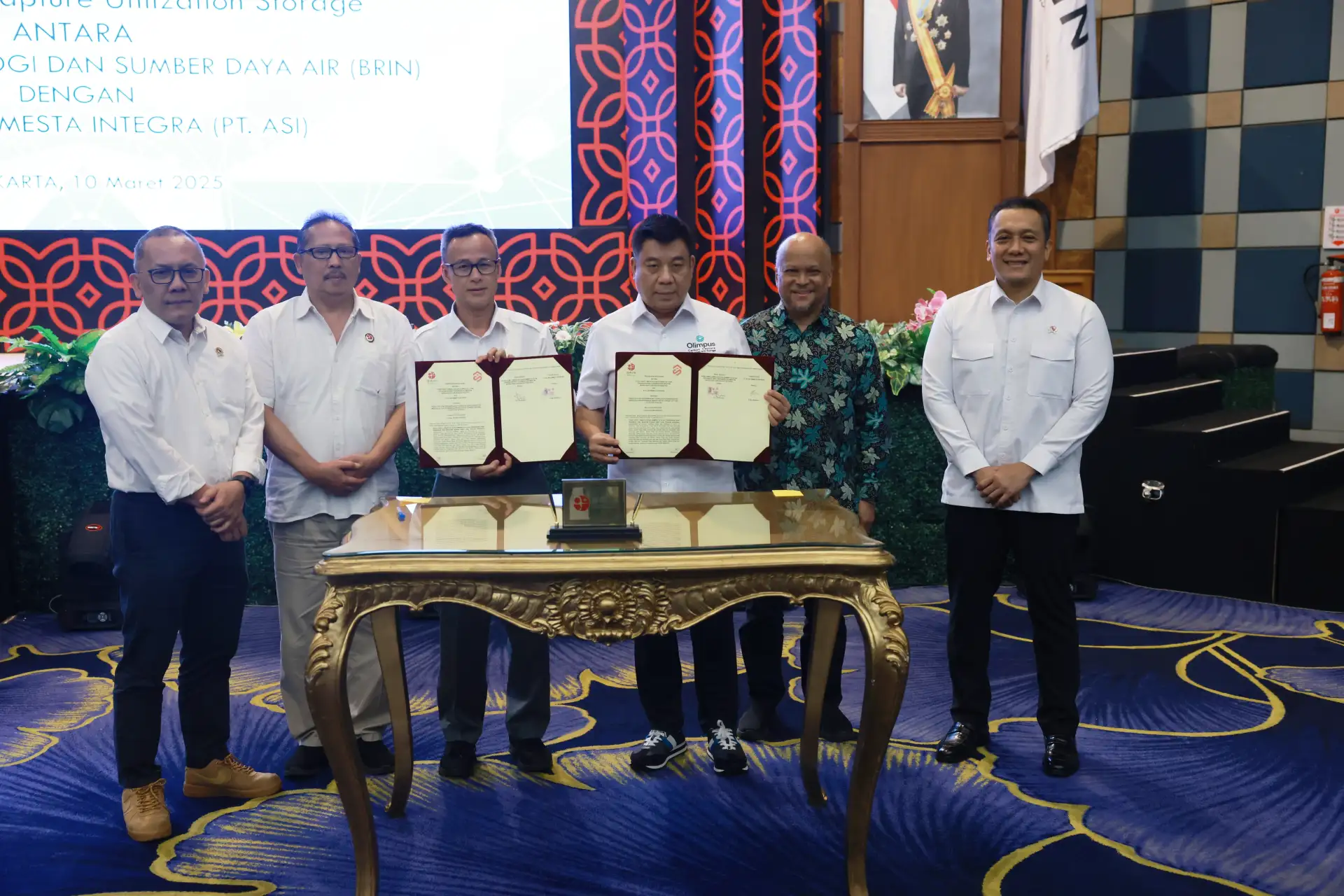
Jakarta-BRIN Public Relations. The National Research and Innovation Agency (BRIN) in collaboration with PT Alam Semesta Integra is developing microalgae-based CCUS (Carbon Capture Utilization and Storage) photobioreactor technology. This technology is expected to be an innovative solution in the effort to reduce carbon emissions and support environmental sustainability.
This collaboration was marked by the signing of a Cooperation Agreement (PKS) by the Head of the Research Center for Limnology and Water Resources (PRLSDA) of BRIN, Luki Subehi, and the Director of PT Alam Semesta Integra, Eddy Setiawan, at the B.J. Habibie Building, Jakarta, on Monday (10/3).
The Chairman of BRIN, Laksana Tri Handoko, stated that research related to CCUS has become one of BRIN's focuses in utilizing Indonesia's biodiversity, including microalgae.
"Indonesia is rich in both microalgae and macroalgae, where in this CCUS technology, microalgae will be utilized to capture carbon dioxide (CO₂) gas," said Handoko.
The microalgae-based CCUS photobioreactor technology is designed as a relatively inexpensive, environmentally friendly system that can be implemented on a large scale with high biomass productivity. The biomass produced not only plays a role in carbon emission mitigation but can also be utilized for various high-value products in the fields of cosmetics, agriculture, and health.
"This technology is not yet fully established." Although it is widely practiced in various parts of the world, at least we can start with capture and utilization," he added.
Handoko said that BRIN is not only present for research but also serves as an enabler for the industry to enter the realm of research, including advanced research such as CCUS.
"We are striving to utilize local natural resources, especially microalgae that by nature absorb carbon dioxide, and that will be optimized." So we can claim it for carbon asset, carbon accounting. "This is important for the Ministry of Environment, hopefully, this can become one of the concrete action plans at the next COP (Conference of the Parties)," said Handoko.
The Head of the Microalgae Photobioreactor Technology Development Research Team at PRLSDA BRIN, Awalina Satya, explained that this technology utilizes microalgae to capture carbon dioxide. This technology has been scientifically proven to enhance the efficiency of carbon dioxide biosequestration by the microalga Spirulina platensis, while simultaneously optimizing the photosynthesis process based on the selection of superior microalga strains, growth medium formulation, and control of irradiance, pH, and temperature factors.
Awalina explained that microalgae are cultivated in a specific container. This container is optimized in its configuration, allowing the microalgae to absorb carbon dioxide optimally.
"Microalgae themselves are inherently capable of absorbing carbon dioxide and producing biomass with a productivity 50 times higher than that of terrestrial plants in general." Moreover, we are engineering it so that it can biologically-physically-chemically absorb more carbon dioxide, by adjusting the medium, selecting the microalgae strains, controlling the light intensity, and the mass transfer system that occurs within the reactor," said Awalina.
The Director of PT Alam Semesta Integra, Eddy Setiawan, revealed that this collaboration is not merely a partnership between research institutions and industry. But concrete evidence that Indonesia has the capacity to create innovative solutions in facing global challenges, particularly in reducing carbon emissions and implementing sustainable-based technologies.
"As we know, the challenge of carbon emissions is becoming increasingly urgent to address." With this collaboration, we hope to present effective, innovative, and applicable CCUS technology across various industrial sectors," he concluded. (tnt/translator:akb)