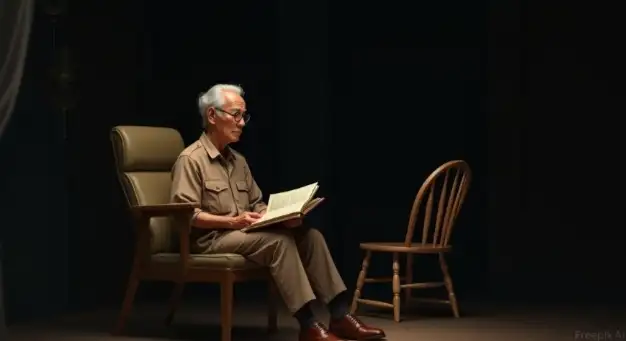
Jakarta-BRIN Public Relations. Pramoedya Ananta Toer (Pram) is known as a political and social activist. He was a writer, cultural critic, and historian of Indonesia. Pram passed away in 2006, but his works remain highly influential and widely read in Indonesia and abroad. Pram is not only remembered as a great writer but also as a thinker who advocated for justice and inclusivity in society.
The figure and works of Pram attracted the attention of BRIN researchers, leading to this topic being discussed in the literary event "One Hundred Years of Pramoedya Ananta Toer: From Literature to History, from Humanity to Resistance," which took place on Thursday (6/3). This event was organized by the Research Center for Manuscripts, Literature, and Oral Traditions (PR MLTL) of BRIN in collaboration with the Indonesian Literature Scholars Association, West Nusa Tenggara Chapter (Himpunan Sarjana Kesusastraan Indonesia Komisariat Nusa Tenggara Bara/HISKI NTB).
From this discussion, it is hoped to be the beginning of a collaboration between BRIN and literature enthusiasts in exploring Pram's thoughts, especially regarding humanitarian issues that are still relevant today. This event features several renowned speakers, including Hilmar Farid, Sumit Mandal, Koh Young Hun, and Max Lane.
The Head of PR MLTL BRIN, Sastri Sunarti, in her speech, said that she became acquainted with Pram's works in the early 80s when she was a student. At that time, she recounted, Pram's books for children from the regions were still considered elite literary works.
"We got the book Bumi Manusia from a senior who had just finished their master's degree at UGM." And we all read that book at that time when it was still banned from being read. Fortunately, Hasta Mitra made it easy for us to obtain and read all of Pram's works until they were reprinted again," he recounted.
Sastri acknowledged Pram's achievements as an Indonesian writer who has left behind extraordinary works. "Pram is not only remembered as a great literary figure, but also for his thoughts and works," he emphasized.
The head of HISKI NTB, Syukrina Rahmawati, said that every Pram novel always provides insight into how Indonesia faces conflicts and counterattacks both verbally and nonverbally, of course, with his extraordinary imagination. "These stories are enveloped in various narrative rhythms, such as romance and the strength of the characters in the story," she said.
Therefore, this webinar, in his view, will be an extraordinary magnet when experts discuss all these matters in depth from different perspectives. For him, Pram's works represent the stories of people from all corners of the country, not only relevant to what is happening in Indonesia.
Present History from a Different Perspective
Then historian and activist, Hilmar Farid, conveyed that in his works, especially the Buru Quartet, Pram offers a historical perspective that differs from the dominant narrative. He presents marginalized figures and highlights how the colonial system operates as an oppressive totality. Pram's narrative is also polyphonic, meaning it gives space to various voices and perspectives that challenge the official version of history. "Pram highlights that Indonesia was born from a collective imagination of resistance against colonialism, not because of ethnic or linguistic similarities," he said.
Hilmar also mentioned that Pram, in his book "Nyanyi Sunyi Seorang Bisu," criticized the failure of the revolution due to the lack of a unified vision and the poverty of imagination. That is the inability to imagine a truly new order of life. This critique is relevant in various recurring crises, from resource exploitation to social injustice.
Through his works, Pram not only presents criticism of colonialism but also invites a re-examination of the nation's direction after independence. The historical imagination he offers becomes an important tool for understanding national identity and seeking a way out of the recurring social and political decline.
Next, Sumit Mandal from the National University of Singapore (NUS) highlighted the ethnic and cultural diversity recognized since the early formation of nation-states like Indonesia and Malaysia, but understood in different ways. According to him, Indonesia emphasizes nationalism that homogenizes identity, while Malaysia maintains ethnic identity separately.
"Pram is considered a writer who offers a unique understanding of Indonesia's diversity." He sees Indonesia as the result of a long historical process that encompasses various cultural influences, including China," said Sumit. In his work such as Hoa Kiau di Indonesia, Pram emphasizes that the Chinese community is an integral part of Indonesian history, not merely a marginalized minority.
Pram's writings reflect a "nationalist" perspective that focuses on the formation of a nation-state society. He also blurred the lines between history and fiction. Believing that history should be written with creativity to make it more engaging and raise awareness.
Once a Nobel Prize Candidate
Koh Young Hun, a South Korean Indonesianist, said that Pramoedya Ananta Toer had been a Nobel Prize candidate since 1980, but was allegedly not awarded it due to the diplomatic stance of the Indonesian government at that time. His works, such as Bumi Manusia and the Buru Quartet, were once banned from circulation because they were considered to contain subversive elements and class conflict.
Nevertheless, Pram is still known as a great writer who highlights issues of humanity, struggle, and Indonesian history. His views are reflected in characters such as Hardo (The Hunt) and Sa’aman (The Guerrilla Family) who face a dilemma between personal and national interests.
In addition, letters and events surrounding Hoa Kiau in Indonesia highlight how Chinese descendants in Indonesia often experience political discrimination. Pram himself was once imprisoned for his writings which were considered dangerous to the country.
“Although his works were once banned, his books are now increasingly popular among the younger generation, showing a high interest in history and humanity. He may not have won the Nobel Prize, but the legacy of his thoughts lives on in literature and the understanding of the nation’s history,” he said.
Writer and historian Max Lane said that the thoughts of Indonesian youth in the late 1950s to the 1980s were heavily influenced by the concepts of nationality and class. In Pram’s novels entitled This Earth of Mankind and Children of All Nations, Pram describes the process of creating the Indonesian nation which required territorial boundaries, a shared economy, a national language, and a new culture. Social class also plays a role, with differences between the priyayi who depend on office and the people who make their own living.
Pram also criticized colonial capitalism and described how indigenous capitalists such as Nyai Ontosoroh and Tirto Adhi Soerjo experienced oppression or exile. In the novels Jejak Langkah and Rumah Kaca, he shows that domestic capitalists had difficulty developing, while the left movement faced repression, which ultimately shaped the political landscape of Indonesia in the 20th century. (SGD/ ed:and,jml/translator:akb)