IDEN
News Detail
Community Involvement is Necessary in Building Fish Passages
Published on February 24, 2025
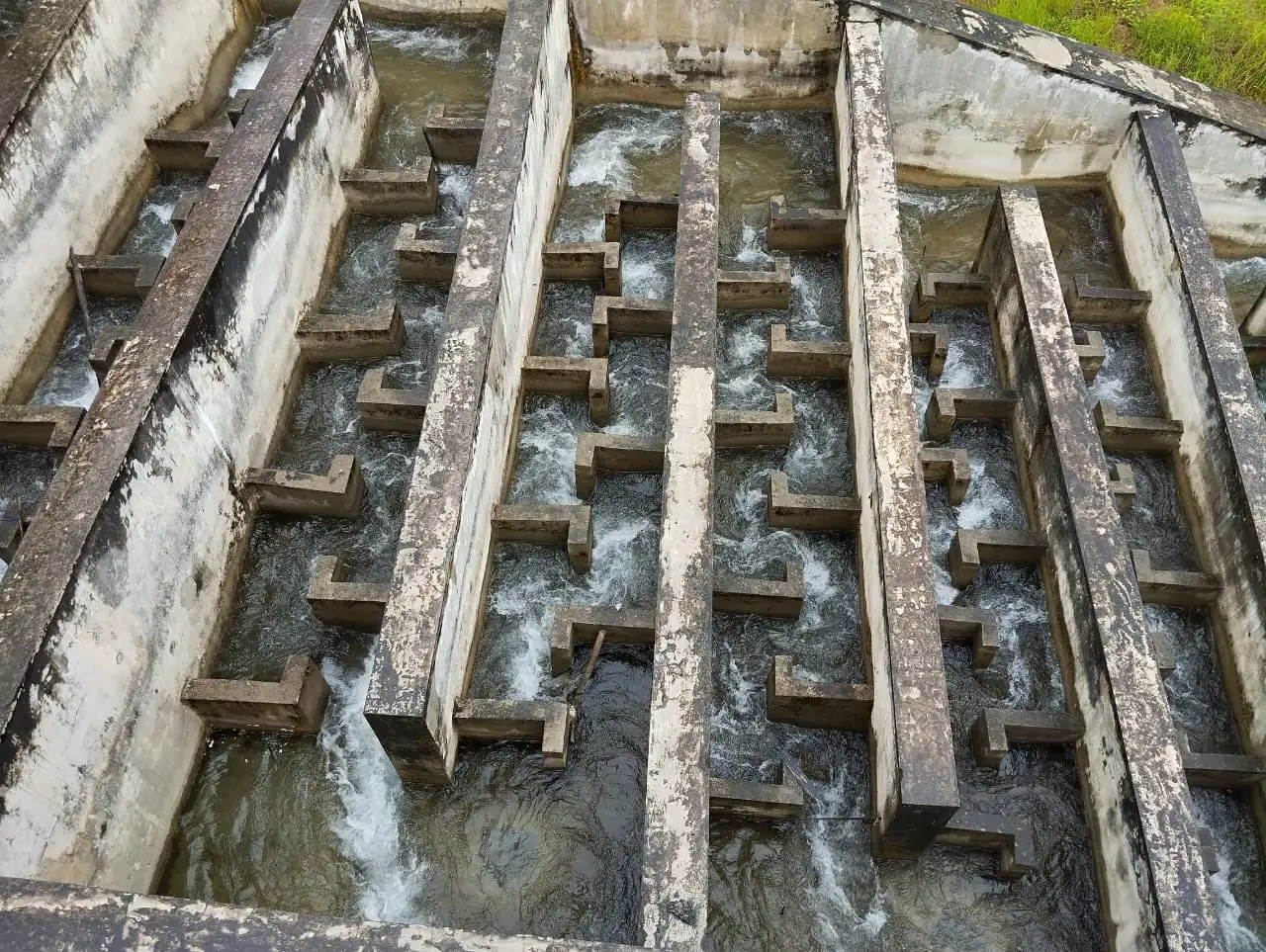
Lintasan ikan di Bendungan PLTA Poso, Sulawesi Tengah (Foto: BRIN)
Jakarta-BRIN Public Relations. Fish passage or fishway is designed to facilitate the migration of fish across river-crossing structures, such as dams or other barriers. However, the Head of the Research Center for Conservation of Marine and Inland Water Resources at the National Research and Innovation Agency (BRIN), Arif Wibowo, stated that the construction of fish passages in Indonesia has minimal community involvement.
"But in fact, the community is very important in maintaining fish migration routes." "Therefore, we need social research to enhance the public's perception of the importance of fish migration routes," said Arif, at the training titled Social Research Training for Fish Conservation Scientists, at the B.J Habibie Building, Jakarta, Monday (24/2).
So far, Arif continued, in fish passage research, his team has only focused on biological aspects, such as the biodiversity of fish found in dams/reservoirs. This is important in building an effective fish passage. Including aspects of turbulence, height/slope, currents, and so on.
"With social research, researchers and stakeholders can gain an understanding of the interconnection between fishway development for food security, energy security, and the availability of protein and nutrients for the community," he said.
In addition, social research is also important to evaluate or assign a value to the significance of the presence of fish in the river. "This must be asked thoroughly to the community, and later we can see what the estimated economic valuation will be," said Arif.
In its implementation, Arif said, fish migration not only has an impact from an ecological aspect but also a social one, especially on communities that depend on fishery resources. Therefore, it is necessary for researchers in the field of fish conservation to understand the use of scientific methods in social research.
"Every natural science research must involve social science." With social sciences, we will understand how the community perceives fish conservation. Not only to the local community, but also to various stakeholders," said Arif.
Arif emphasized that fish passages are necessary to protect fish populations that require migration and to prevent habitat fragmentation. In Indonesia, fish passages are already present in various weirs/dams. In Sumatra, they are found in Perjaya-South Sumatra, Batanghari-Jambi, and Sei Ular-North Sumatra.
Then on the island of Java, it has been built on the Opak River-Yogyakarta. "There are about three fishways already built there." "That's not a dam, but actually a sediment barrier that then has a fishway," said Arif.
As for the fish pathways that have already taken local conditions into account, Arif mentioned, they are found in the Citatih River-Sukabumi. "Interestingly, Sukabumi is the only regency that has a regional regulation requiring that every dam/dam construction must include a fish passage," said Arif.
Meanwhile, in Sulawesi, a fish passage has been built at the Poso Central Sulawesi Hydroelectric Power Plant Dam.
Furthermore, Arif stated that BRIN, together with the Australian Centre for International Agricultural Research (ACIAR) and Charles Sturt University (CSU), has conducted research on fish migration pathways for the sustainable management of river water resources. There are six BRIN researchers currently studying at CSU, who are incorporating social components into their research.
Next, the Crawford Foundation plays a role in providing funding in the fields of social and natural sciences to enhance cooperation between Indonesia and Australia. At the same time, enhancing the capacity of fish conservation researchers to understand social research.
"Thus, the perception of social science can become one of the factors in decision-making in the field of fish conservation," emphasized Arif.
Senior Research Fellow in Environment and Livelihoods, Gulbali Institute, CSU, Joanne Millar revealed that this training aims to provide BRIN researchers with knowledge and skills in fish conservation to understand communities when conducting research.
"Whether they conduct social research or not, it is very important for them to understand the local community and work with them." Then, if they are going to conduct social research, how do they do it ethically and design good questions," Joanne explained.
Then, he continued, how researchers analyze the data, write the results, and present them to the authorities or to the public.
Jo shared his experiences in Asian countries, one of which was a project designing fish passages in Laos. After the fish passage was built, the local community had to manage it because the researchers had completed their task.
"The local community formed a committee to ensure that people would not fish there illegally, so they conduct patrols." Gradually, the community understands the fish routes, although illegal fishing still often occurs," he said.
The training attended by BRIN, the Ministry of Maritime Affairs and Fisheries, and NGOs will last for five days. Jo explained that participants will also visit the Modern Fish Market in Muara Angke and interview traders and consumers.
"My hope is that researchers possess skills and knowledge related to social research, and are motivated and enthusiastic to carry it out," Jo emphasized. (tnt/translator:akb)