News Detail
Determining the Onset of the Hijri Month: Combining Astronomy and Rukyat in Hilal Determination
Jakarta - BRIN PR. The determination of the beginning of the Hijri month, especially Ramadan, Shawwal and Dhul Hijjah, is one of the things that always concerns Muslims around the world. Astronomy and the rukyat method are the two main approaches in determining the new moon, which often lead to different views. Research Professor of Astronomy-Astrophysics at the National Research and Innovation Agency (BRIN) Thomas Djamaludin explained that astronomy and phalac science play an important role in determining the position of the hilal scientifically.
According to Mr Djamaludin, astronomy is the study of celestial bodies, including the movement of the sun and the moon, while phalactic science is a part of astronomy that is linked to the postulates of sharia for the purposes of Muslim worship. “In determining the hilal, astronomy is used to calculate the position of the moon, the height of the hilal, and the distance of the moon from the sun to predict whether the hilal can be observed or not,” Thomas said in an interview at BRIN Office, Jakarta, Monday (24/02).
He added that in Islam, the determination of the beginning of the Hijri month was initially done through the rukyat method or direct observation of the hilal. This is based on the Prophet Muhammad's hadith, which means fast if you see the moon and break the fast if you see the moon. As the science develops, the hisab method or astronomical calculations are used to estimate the position of the hilal before observation.
Thomas emphasised that the hisab method has developed very rapidly and has a high level of accuracy. “Currently, astronomical calculations are very accurate, even for solar or lunar eclipses can be calculated to a matter of seconds,” he explained.
However, he also reminded that although hisab is very accurate, most Muslims still want proof by rukyat.
Differences in the determination of the beginning of the Hijri month are often not caused by differences in hisab and rukyat methods, but by the different criteria used by various Islamic organisations and the government. In Indonesia, for example, the criteria used by the government are different from Muhammadiyah, but the same with several other Islamic organisations. This difference causes differences in determining the beginning of Ramadan, Eid al-Fitr, and Eid al-Adha.
In addition, geographical factors and weather conditions also affect the rukyat method. Very thin hilal can be obscured by twilight or cloudy weather, making it difficult to observe with the naked eye. “One of the biggest challenges in rukyat is the contrast of light. Hilal is very thin and is often less bright than twilight,” said Thomas.
To overcome this obstacle, astronomical technology continues to be developed to improve the accuracy of hilal observations. One of the technologies currently used is a telescope with a digital camera and image stacking image processor, which can increase the contrast of hilal images by stacking hundreds of images in one frame. “This technology allows very faint hilal to be seen more clearly,” he added.
Thomas also explained the difference in determining the beginning of the Hijri month between Indonesia and Saudi Arabia. Logically, Indonesia, which is further east, should set the beginning of the month first. However, in recent years, Saudi Arabia has set Eid al-Fitr or Eid al-Adha first. “This is more due to differences in government decisions of each country, not because of differences in hisab or rukyat methods,” he explained.
Regarding the latest developments, Thomas revealed that since 2021, the government and Islamic organisations in Indonesia have updated the criteria for determining the hilal, namely a minimum height of 3 degrees and an elongation of 6.4 degrees. Muhammadiyah, which previously used a single global Hijri calendar criterion, has now returned to using the wujudul hilal method. Nonetheless, differences in the determination of the beginning of the Hijri month will likely still occur.
As a national research institution, BRIN has an important role in the development of astronomy to support more accurate and scientific hilal determination. Through the Centre for Space Research, BRIN provides support for better quality hilal monitoring as input for the Indonesian Ministry of Religious Affairs' isbat session. “We continue to provide input based on astronomical research and innovation to ensure that the methods used in hilal determination are more accurate and acceptable to all parties,” Thomas concluded.
With continued education by research institutions and the government, it is hoped that differences in the determination of the beginning of the Hijri month will be resolved, and the public can better understand the scientific method in determining the hilal.
Prediction of the beginning of Ramadan 1446H
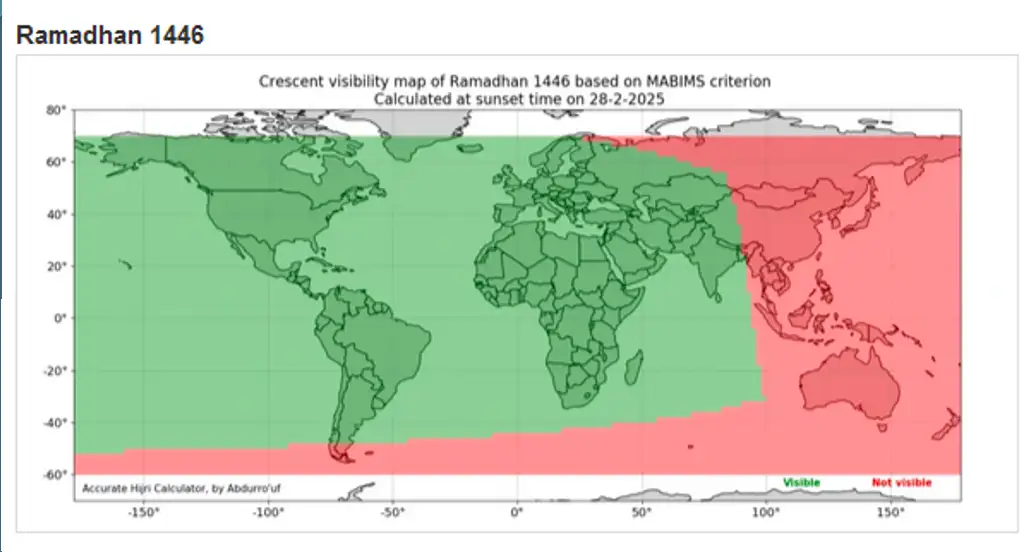
Based on the date line analysis, on 28 February 2025 at maghrib in Indonesia, the position of the moon has met the MABIMS criteria in the Aceh region, with the moon position in Banda Aceh as follows: Topocentric height: 4.5o Geocentric elongation: 6.4o Slightly exceeding MABIMS criteria: Height >3o, elongation >6.4o.
With these conditions in Aceh, the beginning of Ramadan in the lunar calendar is 1 March 2025. However, since only Aceh has met the criteria and given that the weather may be cloudy, there is a possibility of rukyat failure, so potentially 1 Ramadan will fall on 2 March 2025.
However, the determination of the beginning of Ramadan 1446H awaits the results of the isbat session conducted by the Indonesian Ministry of Religious Affairs.
For more information, check out BRIN TV channel: