IDEN
News Detail
Prevent Extinction, Revitalization of Various Regional Pantun Styles Needed
Published on February 12, 2025
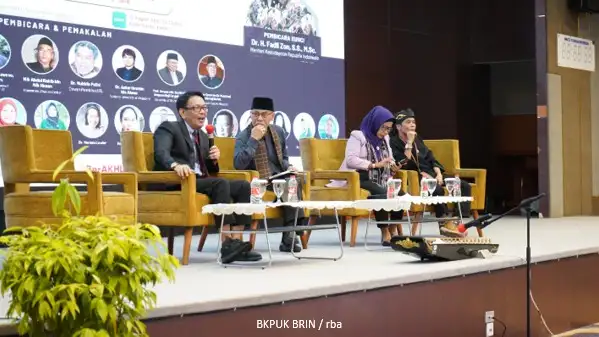
Jakarta-BRIN Public Relations. Pantun is one of the forms of oral literature that has long developed in Malay culture. Pantun is not just a series of rhythmic words, but also has a deep meaning that reflects life values, the beauty of language, and moral teachings.
This was conveyed by Abdul Malik, Professor of Indonesian Literature and Language at Raja Ali Haji Maritime University, Tanjungpinang, during his presentation session at the Nusantara Pantun Seminar. This event was organized by the National Research and Innovation Agency (BRIN) in collaboration with the Oral Tradition Association (ATL), on Tuesday (11/02), at the BRIN Campus Sarwono Prawirohardjo Science Area, Jakarta.
In his presentation, he highlighted the maritime character in the Nusantara pantun by analyzing it from the perspective of Malay literary studies. He emphasized that the language in pantun must be correct and in accordance with the guidance of noble values. "Pantun not only pays attention to aesthetic form, but also has a deep meaning." This is reflected in works such as Haji Ibrahim's pantun from 1877, which contain elements of linguistic beauty and life wisdom," he explained.
He continued, a good pantun must meet two important elements, namely the series of the beach and the series of the mountain. The coastal series reflects beauty that is seen up close, characterized by the physical and worldly. Meanwhile, the mountain series reflects beauty that is seen from afar, characterized by its meaningful and divine nature. If a literary work meets both of these elements, according to him, then the poem can be categorized as a high-quality work.
Next, Nik Abdul Rakib Bin Nik Hasan from the Nusantara Studies Center Thailand shared a story about a figure from Southern Thailand who expressed his views on the condition of Malay culture and language in the region. He revealed that the Malay community there, numbering around two million people, faces significant challenges in preserving their cultural identity due to assimilation policies. One of the tangible impacts of this policy is the decrease in the number of Malay speakers, as many of them are now more fluent in Thai.
However, there are efforts to preserve and revive Malay culture. That is in integrated Islamic religious schools, which combine the government curriculum with religious education, still include the Malay language and literature, including pantun, in their curriculum.
In addition, there are various community initiatives, including groups that collect and document Malay pantun from various sources in Malaysia and Indonesia. Some individuals even upload collections of pantun to blogs to reintroduce this oral literature to the younger generation in the digital era.
"In the end, the preservation of Malay culture in Southern Thailand requires cooperation from various parties, both domestically and internationally." Support from the Malay communities in Malaysia, Indonesia, Brunei, and Singapore is needed so that Malay culture and language remain alive amidst the challenges of modernization and assimilation," he explained.
Mu’jizah, a researcher at the Research Center for Manuscripts, Literature, and Oral Traditions (PR MLTL) of BRIN, in her presentation "Transformation of Betawi Pantun: Between Tradition, Popularity, and Humor," stated that pantun is part of the cultural wealth that reflects the identity of a society. In the context of Betawi, pantun has become an integral part of various traditions and performing arts.
"The Betawi community has a close relationship with pantun, which is present in various traditional ceremonies and performing arts," he said. Some traditions that always include pantun, he mentioned, include traditional wedding rituals (palang pintu), circumcision, hatam quran, and Maulid celebrations. There are also performing arts such as ondel-ondel, gambang rancak, and narratives in stories like Si Pitung. Meanwhile, in religious and social ceremonies, such as housewarming, pilgrimage departures, and earth almsgiving.
Mu’jizah revealed that, along with globalization, the pantun has undergone quite significant changes. Several aspects that have undergone changes include structure and style, shifting from the classical form with perfect rhymes to a more free form. Then, the element of humor is present in the tradition of palang pintu. Here, the element of humor becomes more prominent, serving as entertainment and a social glue. Then, in the shift of meaning, the pantun, which used to be a measure of linguistic intelligence, is now more often used as light entertainment in various events.
Some pantun in performing arts, such as gambang rancak and the story of Si Pitung, he explained, show a difference in style between those that are poetic and those that are story-based. This indicates the flexibility in the use of pantun according to the needs of the times.
She then continued, the Betawi pantun has a dynamic that continues to evolve, both in tradition and in modern adaptation. Although it has undergone changes in form and function, the preservation of Betawi pantun can still be carried out through strategies that align with their respective goals. With in-depth studies of old manuscripts and contemporary pantun, he hopes that Betawi pantun will remain preserved as part of the nation's cultural identity.
Meanwhile, from the perspective of Dede Burhanudin, a researcher at the Research Center for Treasures of Religion and Civilization (PR KPP) of BRIN, he delves into the story of pantun in the farming tradition of indigenous communities in West Java and Banten, focusing on the function of the story in the Ciptagelar indigenous community. Dede said that the pantun serves as an oral story in the form of old Sundanese literature presented through exposition (prologue), dialogue, and often sung. The art of Pantun is performed by a bard (tukang pantun) accompanied by the musical instrument kecapi, which he plays himself.
It was also mentioned that since the 16th century, pantun as a narrative unit has been consumed by the Sundanese community as a means of entertainment as well as a moral reference. Sundanese pantun is also known as satire. Sundanese pantun covers a variety of themes ranging from life advice, education, daily life, to love and jokes, showcasing the richness of Sundanese culture and language in poetic expression.
"The variety of humorous and entertaining pantun in Sundanese sisindiran reflects the Sundanese people's tendency to use humor in communication, teach values, and convey social messages in a subtle and entertaining manner," said Dede. (Noor/ed: And, mfs/translator:akb)