IDEN
News Detail
Eroded Middle Class: Challenges and Strategies for Indonesia's Economic Recovery
Published on December 11, 2024
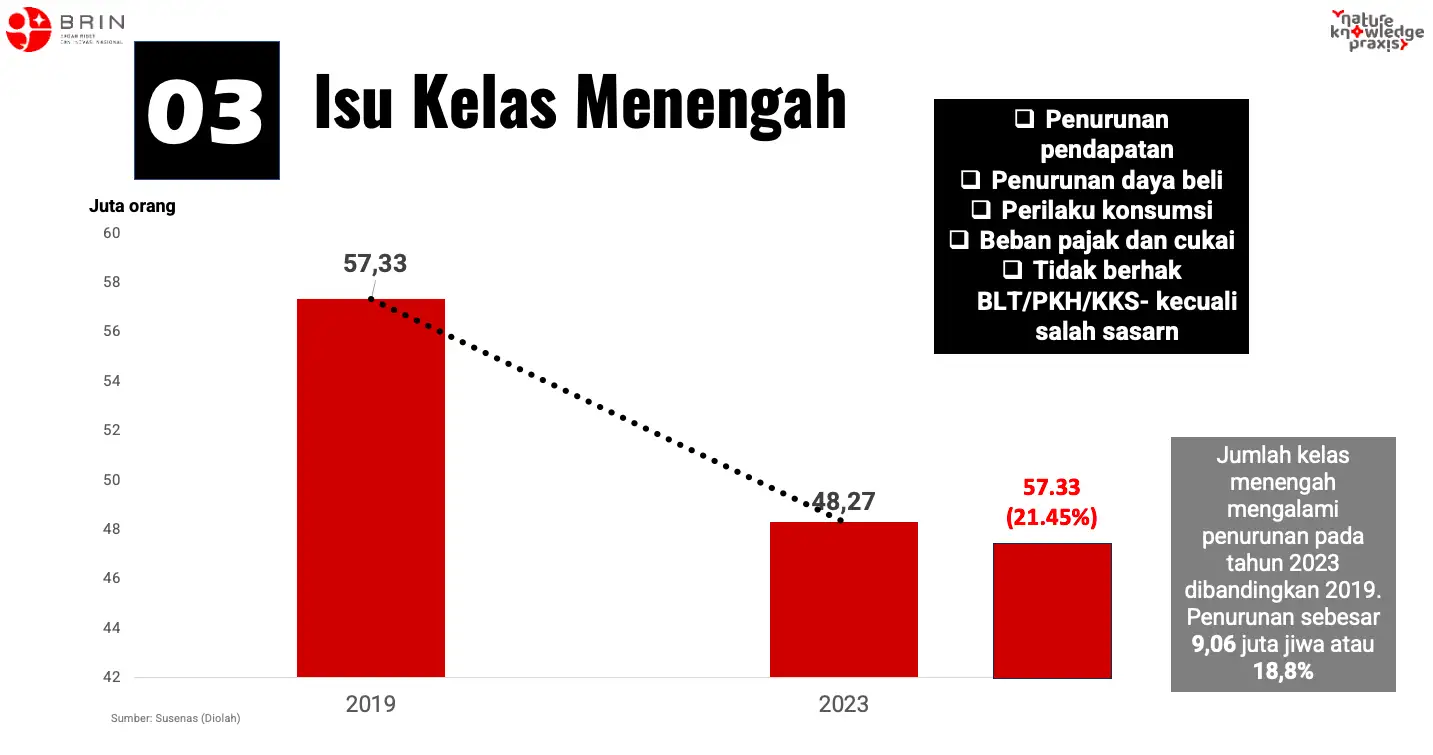
Jakarta-BRIN Public Relations. The decline in the number of middle-class people in Indonesia became a major issue in the Economic Outlook 2025 held by the National Research and Innovation Agency (BRIN) at the BRIN Office in the Gatot Subroto area, Wednesday (11/12). The Head of the Research Center for Macroeconomics and Finance, Zamroni Salim, mentioned that the number of the middle class has decreased significantly by 18,8% in recent years, from 57,33 million to 48,27 million. This decline directly impacts purchasing power, domestic consumption, and national economic stability.
According to Zamroni, one of the main causes of the decline in the middle class is the increasing economic pressure, including rising taxes and living costs. "The middle class faces a heavy burden, such as the increase in income tax rates, additional levies like TAPERA, and taxes on sweetened food and beverages. This narrows their economic space," he explained.
In addition, domestic consumption, which has been the main driver of economic growth, has also been affected. The decline in the purchasing power of the middle class hampers the growth of the production sector, which ultimately limits job absorption. "This condition creates a domino effect on the manufacturing and service sectors, which depend on the stability of middle-class consumption," as explained by Zamroni.
Solutions to address this decline, according to Zamroni, must focus on policies that support the middle class, such as tax relief and economic incentives. "The government needs to review policies that burden the middle class." Support such as energy subsidies or more inclusive social programs can help improve their purchasing power," he added.
Additionally, Zamroni emphasized the importance of quality investments to create new jobs in strategic sectors, such as manufacturing and technology. "Investments with high multiplier effects, such as in the textile, food, and technology-based industries, should be prioritized to strengthen the middle class," he asserted.
The government is also expected to be more proactive in improving the quality of human resources through education and health. "Improving the quality of human resources will open opportunities for the middle class to grow again and contribute significantly to the economy," he said.
Additionally, Zamroni emphasized the need to focus on areas with low Human Development Index (HDI). "Underdeveloped regions such as Papua, Maluku, and South Kalimantan require special attention to improve the quality of life and economic access for their residents," said Zamroni.
Through a combination of policies that support the middle class and increased quality investments, Zamroni is optimistic that Indonesia can restore the stability of the middle class as the main pillar of economic growth. "The middle class is the heart of our economy. Keeping them strong means securing the future of Indonesia's economy," he concluded. (Pur/translator:akb)