News Detail
BRIN researchers explain that Indonesia has 21 out of 27 Durian species in the world
Cibinong-BRIN Public Relations. Durian has an important economic value in several provinces and is one of the main commodities. Durian fruit production ranks sixth after banana, mango, orange, rambutan, and salak. The regions with the highest durian production are East Java, West Sumatra, Central Java, North Sumatra, and West Java. While the harvest area in the form of trees and durian fruit production from 2019 to 2022 varies.
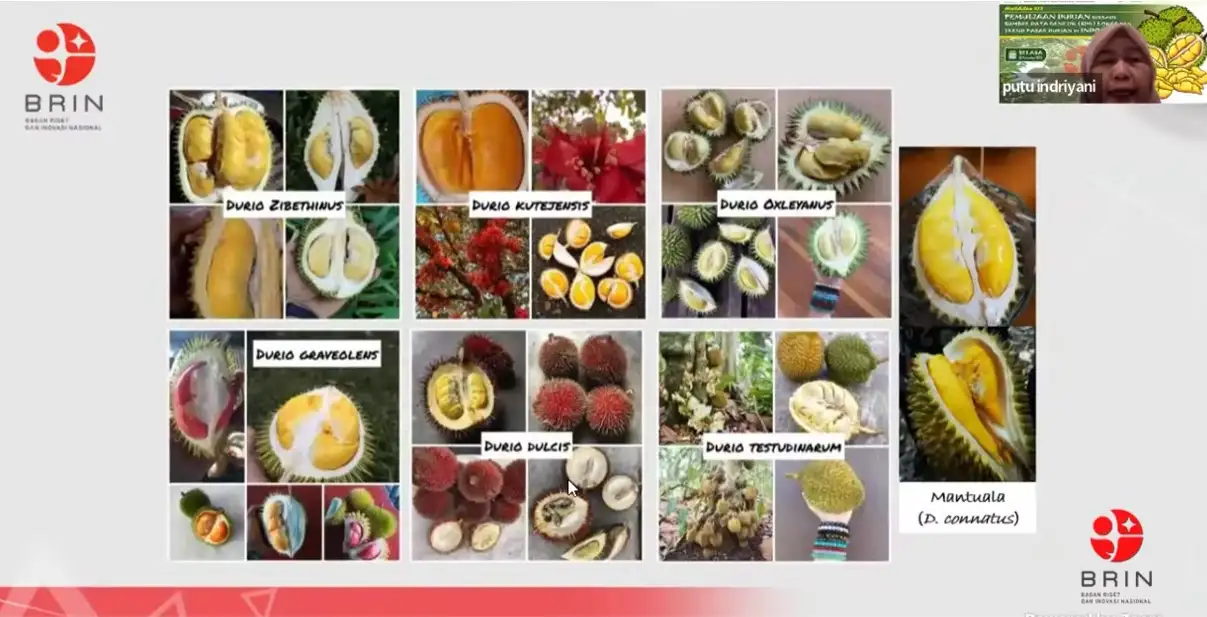
Talking about plant breeding is inseparable from genetic resources, as a source of genes in plant breeding programmes to assemble new superior varieties. Indonesia has 21 of the 27 durian species known in the world, and until 2024 approximately 114 varieties are registered for new superior varieties.
“There are still countless wild and unidentified durian species, coupled with its characteristics that have open pollination, adding to the genetic variability in nature,” said Ni Luh Putu Indriyani, an Associate Expert Researcher at the Horticultural Research Centre of the National Research and Innovation Agency (BRIN) during the HortiActive#13 webinar with the theme “Durian Breeding Based on Local Genetic Resources (SDG) and Durian Market Trends in Indonesia” on Tuesday (26/11).
According to Indriyani, research on durian Genetic Resources (SDG) that has been carried out includes characterisation and evaluation, exploration of regional superior durians, crosses between selected elders.
Then the evaluation of growth performance and fruit quality of the crosses, as well as the management of durian character database through the available website.
“The location of durian plantations in the Subang Experimental Garden in 2010 had 550 plants with 79 accessions. In 2016, the final number of plants was 768 plants and 84 accessions, while at KP. Aripan there were 228 plants with 36 accessions, and in 2019 there were 467 plants with 89 accessions,” he explained.
He revealed that the new superior durian varieties have ideal characters to support the desired high productivity of durian. For Indonesian consumers, the desired characters are medium-sized weighing 1.6-2.5 kg, yellow flesh, sweet, fluffy, thick, and small seeds. While traders want durian to be shelf-stable and not easily broken, planters want productive durian varieties that are disease-resistant and early maturing.
“New superior varieties can be obtained through indigenous or native selection and their nature is open pollination, so cross-pollination always occurs. Seeds from cross-pollination that occurs naturally are the material for selection to produce new superior quality. Artificial breeding is also done between varieties or between species,” he explained.
The durian breeding programme in Indonesia, according to him, was carried out starting in 2010 with locations at KP. Subang and KP. Aripan. The elders used are Matahari, Kani, Otong, Sitokong, and others.
“Because durian plants are annual plants that take a long time to find out the results of crosses, molecular marker activities become very important in accelerating the breeding process,” he explained.
Analysis of Locus and Diversity of Durian Genetic Resources (Durio sp) based on Microosatellite Markers, from 10 Microosatellite loci known to have polymorphism and informativity levels vary from low to high levels.
“The DzMTa005 and DzMTa006 loci have the potential as informative molecular markers to determine the diversity of durian populations. The distribution of alleles is quite evenly distributed among the 94 durian SDGs used in inter-population genetic variation is quite high, and proves that Kalimantan as the centre of origin spreads to other regions,” she said.
Durian, Indriyani explained, is an annual plant that takes a long time to know the results of crosses. Therefore, molecular markers are needed to accelerate and support conventional breeding programmes.
“There are several challenges faced, including Pythium pests and diseases that cause plants to suddenly molt and die. Stem borers are insects that make holes in the stems, which eventually weaken and kill the plants. Irrigation problems with water pump damage, where when the water pump is damaged, irrigation is disrupted,” she explains.
The next challenge, continued Indriyani, is the dry season when water sources dry up, the plants experience water shortage, which has a significant impact on their growth. Plant safety is compromised by damage to young plants, for example, the tips of young plants are often damaged or cut, causing them to break, as well as fruit theft during harvest.
“Limited funding is also a challenge because durian was not included in the list of priority commodities, so funding is very minimal. This has a direct impact on plant maintenance in the field, because the focus of funding is more directed at other priority commodities, so that durian maintenance becomes less optimal. This limited funding certainly has an impact on the quality of plant maintenance in the field,” Indriyani concluded.