IDEN
News Detail
Threatened with Extinction, Rote Turtle Conservation Involves Community
Published on November 26, 2024
Cibinong-BRIN Public Relations. Rote Island turtle (Chelodina mccordi) is one of the 25 most endangered turtle species in the world and is an endemic turtle of Indonesia.
Now, the turtle faces a serious threat of extinction. The causes include its very small population in the wild, its natural habitat being almost depleted, and the lack of management for species conservation.
Senior Researcher at the Research Center for Applied Zoology of the National Research and Innovation Agency (BRIN), Kayat, said that since 2009, breeding efforts have been carried out involving the local community. One of the successes achieved is the increase in turtle reproduction in captivity.
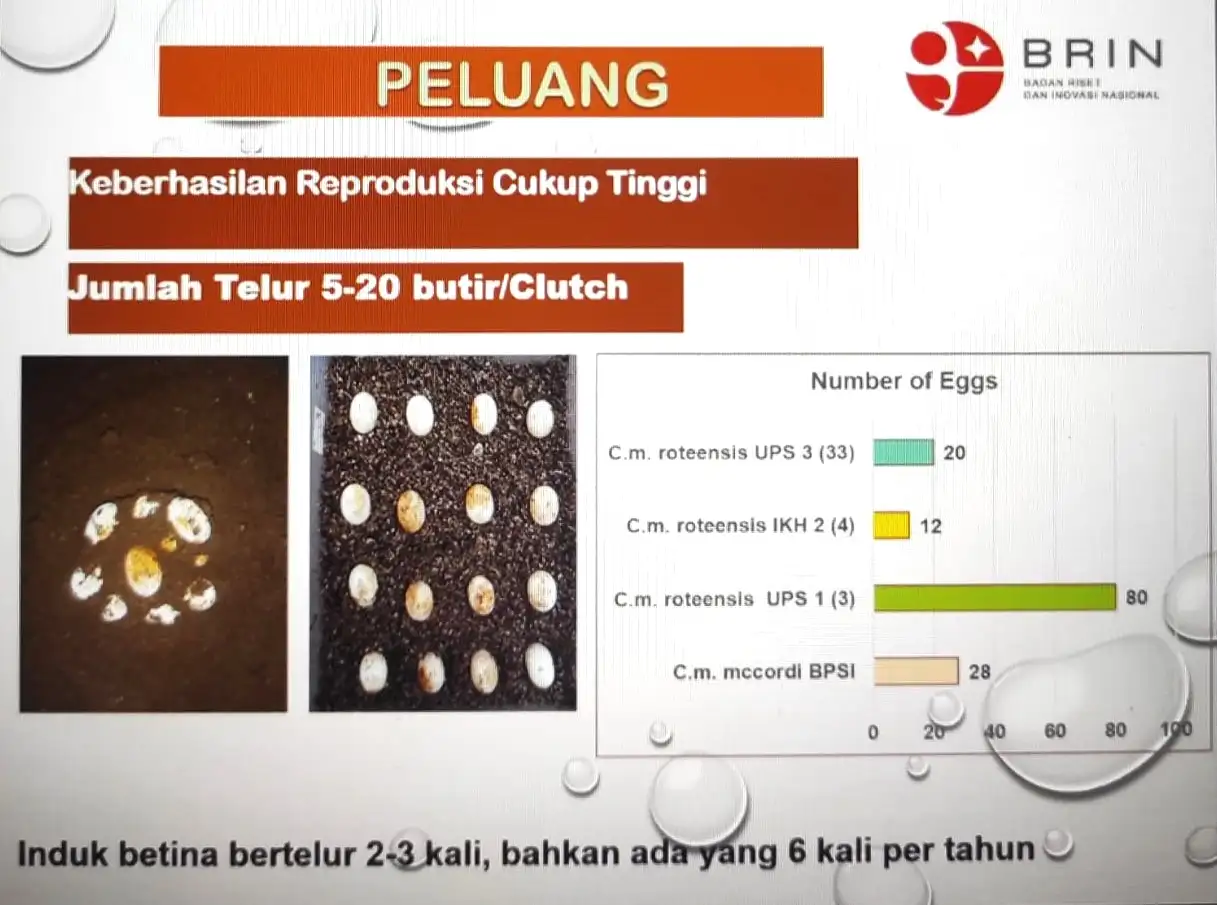
"This species has a high reproductive potential with an egg count reaching 5 to 20 eggs per laying, and an egg hatching rate of up to 100 percent. This is much higher compared to other turtle species," explained Kayat during the Sharing Session Applied Summer School #14, Friday (22/11).
Kayat explained that each female can lay eggs up to three times, and some even six times a year. However, the survival rate is still below 50 percent due to various factors, including disease outbreaks.
For this reason, intensive research is conducted to improve the health of the hatchlings, especially at the age of 0 to 3 months.
Research shows that turtles released at the age of four have a greater chance of survival compared to those released at a younger age. "This serves as a guideline in the turtle reintroduction program to their original habitat," as added by Kayat.
He emphasized that involving the community is key in the conservation of Rote turtles. Most of the turtle habitats are located on community-owned land, not in official conservation areas.
A community-based participatory approach was implemented, such as designating several lakes as local protection areas.
"We are also working on restoring the vegetation around the lakes to maintain the habitat's sustainability. Additionally, the community is involved in the management and supervision of the turtle habitat," explained Kayat.
The economic potential of turtle conservation, according to him, can also attract the community. "With this strategy, we hope the community can see conservation not just as a responsibility, but also as an economic opportunity," he hopes.
Kayat emphasized the importance of sustained support from various parties, including both central and local governments, researchers, and the community. He is optimistic that through scientific approaches and active collaboration, the population of Rote turtles can be restored.
"Hopefully, the Rote turtles, which are now nearly extinct, can once again become an important part of the Rote Island ecosystem. Future generations should have the opportunity to see this species living in the wild," said Kayat.
Once Abundant
The Rote Island tortoise was first identified as a new species in 1994. Previously, this species was considered the same as the Papuan snake-necked turtle.
In the 1970s to 1990s, the population of these turtles was still abundant. Rote turtles were often found by farmers while plowing fields. However, their population began to decline drastically due to poaching and habitat destruction.
"In 2005, the last recorded sale of rote turtles occurred, and since then this species has been declared de facto extinct in the wild," he revealed.
Nevertheless, the government only provided official protection in 2018 through Permen LHK No. P.106/MENLHK/SETJEN/KUM.1/12/2018. In addition, the role of the Species Specialist Group (SSG) is very important for assessing and making decisions on species status.
The original habitat of the Rote tortoise, which consists of rice fields and natural lakes, continues to shrink. Of the 33 historical habitat locations, only three lakes are still suitable for habitation, namely Lake Ledulu, Lake Lendeoen, and Lake Peto. All of them belong to the community and are located outside the forest area.
Intensive agricultural activities, pesticide use, and land-use changes are the main causes of habitat degradation.
Another threat comes from predators such as wild boars and snakehead fish that prey on turtle eggs and hatchlings. In addition, the entry of invasive species and toxic waste into the habitat further worsens the conservation conditions.
Therefore, Kayat emphasized that the conservation of Rote turtles serves as an important reminder of human responsibility towards the sustainability of biodiversity. With dedication and cooperation, the preservation of this species is not impossible. (ms/ed:sl, tnt/translator:akb)