News Detail
More than 80 species of flora and fauna revealed from the reliefs of Borobudur Temple
Cibinong - BRIN Public Relations. Borobudur Temple is an important object in various scientific disciplines, including biodiversity studies. This temple has more than 1,460 reliefs that tell many things, such as Karmawibhangga and Lalitavistara. Regarding flora and fauna, more than 80 species of flora and fauna have been identified from the two story narratives with the meaning of their appearance not yet known in the story.
This was conveyed by the Head of the Biosystematics and Evolution Research Center (PRBE), Biological and Environmental Research Organization (ORHL), National Research and Innovation Agency (BRIN), Arif Nurkanto, when opening the 55th "Session of Sharing" webinar with the topic "Panel Secret: QUEER! Narrative of the Flora Fauna and 'Post Human' Karmawibhangga Borobudur Story Panel, Thursday (24/10).
“The question that arises is whether the reliefs are only decorative or have symbolic meaning. This is an important topic that has not been fully resolved since research began in 1920," explained Arif.
In the "Session of Sharing" Ibnu Maryanto discussed the study of "Cognitive Science" or the multidisciplinary sciences of biology, philosophy, philology, anthropology, archeology and religion, culture, although only 1-2 panels were discussed. From a cognitive perspective, it shows that the holisticization of story panels has gone beyond or was discussed in detail in the 7th-8th centuries.
Resource person Ibnu Maryanto, Research Professor from the BRIN Biosystematics and Evolution Research Center, explained that Borobudur Temple, which was built in the 7th and 8th centuries, holds many secrets, including Karmawibhangga relief panels hidden underground. Hiddenness These panels were deliberately not shown to the public to protect the structure of the temple, in accordance with UNESCO's decision.
"A multidisciplinary study of this relief involving experts in flora, fauna, philology, ethnography, and anthropology, archaeology, culture and religion using a queer-ecology approach that explores the relationship between flora, fauna and humans in the Karmawibhangga relief, has brought out cognitiveization above reason. "which can be practiced in today's life or the implementation of culture is actually much more advanced in the era when Borobudur was first founded," said Ibnu.
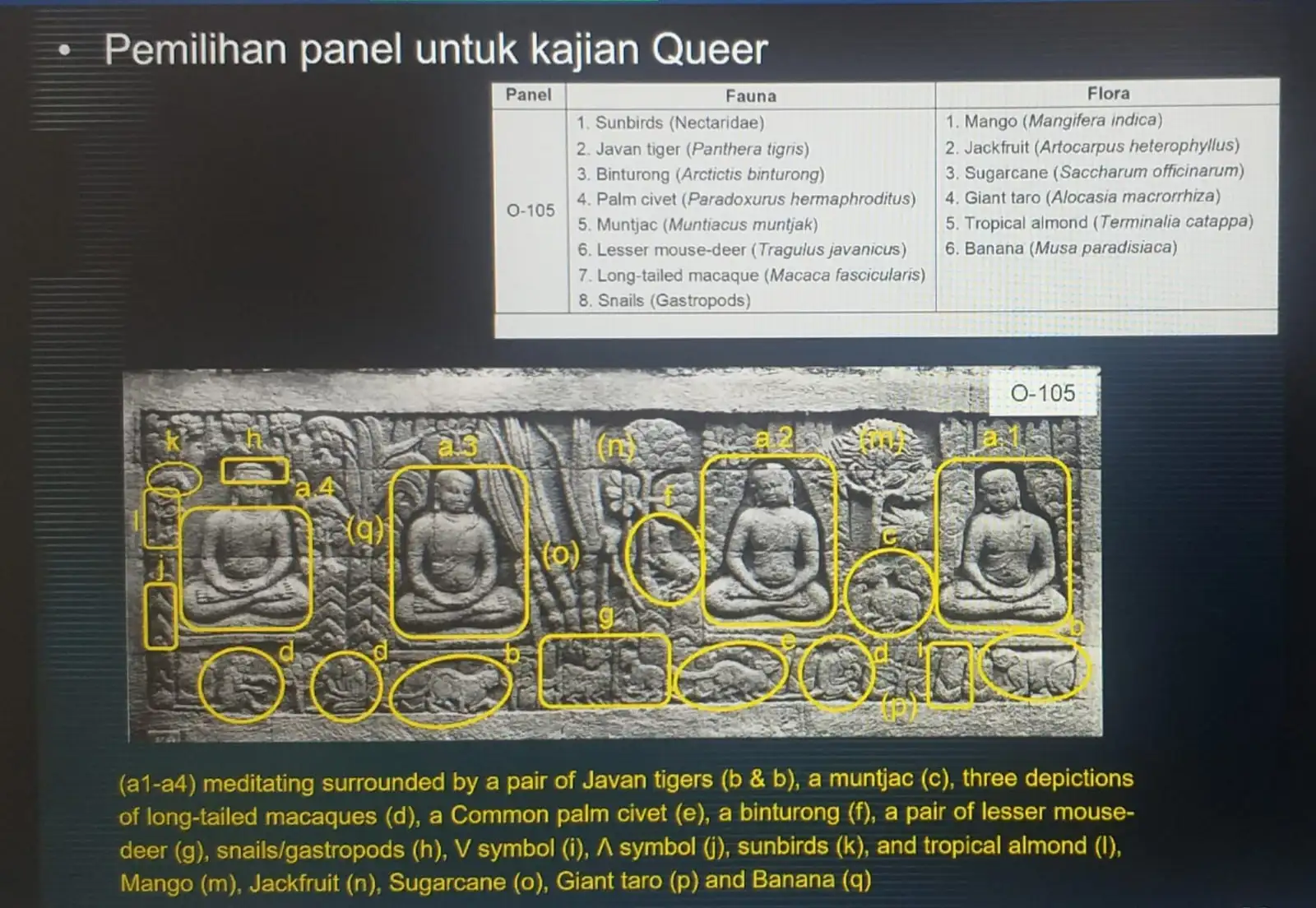
One of the latest publications, Queering Tropical Heritage: Flora and Fauna Reliefs in Karmawibhangga Borobudur Temple, Indonesia, is a new discovery of the perspective of equality between Anthropocentrists, flora, fauna and other post-human objects, not only the principle of the law of karma is demonstrated, but can also be used in nature management as well as an important ecological indicator.
Ibnu added, through tropical intra-textual, extra-textual and queer-ecology approaches, this study highlights the important role of flora and fauna in tropical cultural heritage, as well as how they see flora, fauna and nature as equal to humans, breaking hierarchies or undoing normativity which is generally considered valid.
“This research shows that Borobudur not only highlights artistic aspects, but also challenges established norms. This study with a queer ecology perspective promotes equality between humans, animals, plants, nature, etc. and proposes deconstructive strategies to reduce discrimination in social life, and in reality fauna and flora are often marginalized. "Thus encouraging fairer interactions in social, cultural and ecological contexts," he explained.
“The Karmawibhangga relief, which has 160 panels, depicts the human journey from birth to death through the law of cause and effect (karma). The depiction of flora and fauna in this relief shows very accurate detail, providing insight into the natural riches immortalized by the sculptor. "Identifying the carved plants and animals helps understand the meaning behind the reliefs," explained Ibnu.
Ibnu Maryanto explained that the Karmawibhangga Relief at Borobudur Temple is a comprehensive record covering the artistic, cultural and social dimensions of Ancient Javanese society. This relief not only functions as an ornament, but also as a means of conveying important teachings, especially regarding the basic concept of Panca Skanda, an important teaching in Buddhists. In these reliefs, it is depicted how human actions interact with the environment, as well as the consequences of each action taken.
One of the key elements in Karmawibhangga is the depiction of flora and fauna. These ornaments are not only used as decoration, but also have a deep purpose, namely depicting cultural values and human relationships with the natural surroundings. The flora and fauna in these reliefs function as important symbols that teach moral, social and spiritual lessons.
"Deconstruction and reconstruction of the depiction of flora and fauna in Karmawibhangga is an important step in understanding more deeply the meaning contained therein. "Through this approach, we can see how these ornaments are not just artistic decorations, but are an integral part of the complex teachings and culture of Ancient Java," said Ibnu.
Thus, the Karmawibhangga relief becomes more than just a work of art; it is a source of in-depth learning about life, human interaction with nature, and the values held by society at that time.
“The flora and fauna reliefs on the Borobudur panels show accurate and profound proportions, providing insight into the natural riches immortalized by the sculptors. "Identification of these plants and animals is very important to understand the meaning behind the reliefs," explained Ibnu.
He said that this study also saw Borobudur as more than just a place of worship; Many believe that this temple also functioned as a learning center during its time. With reliefs depicting flora and fauna symbols, we can see traces of biodiversity, as well as the relationship between humans and nature that has been studied for a long time.
"Actually, Borobudur is a "BOOK STONE UNIVERSITY", the study of life science philosophy is discussed in a series of panels and stupas from the bottom to the top," said Ibnu.
One of the difficulties in this study was that when drawing conclusions regarding the identification of flora and fauna, it turned out that the sculptor had deliberately created morphological structural forms of flora and fauna that could only be identified when viewed from an upward, downward and forward perspective. All identification results and perspectives for identifying them all have different and meaningful meanings.
Furthermore, it is also said that the types of flora and fauna revealed in the right, middle and left positions provide important meaning in narrating the story. For example, the presence of fauna in each panel indicates the time (morning, afternoon, evening, night) and location of the event, as well as symbolizing certain socio-cultural values. Flora, on the other hand, symbolizes human life and depicts the diversity of plants that were utilized by the people of Ancient Java.
This research shows that texts such as Candra/Surya Sangkala, Primbon, Pawukon, Usada, and Babad play an important role in interpreting flora and fauna symbols on Borobudur reliefs. Therefore, the term Borobudur as BOOK STONE UNIVERSITY needs to be echoed.