News Detail
BRIN Researcher Explains Carbon Trading as Emissions Trading
Bandung - BRIN PR. Arief Darmawan, an engineer at the Climate and Atmospheric Research Centre (PRIMA) of the National Research and Innovation Agency (BRIN), explained that carbon trading is known as emissions trading or carbon market. It is a market-based mechanism that allows countries, companies, or organisations to buy and allow or credit greenhouse gas (GHG) emissions.
“The goal is to limit overall emissions and incentivise the reduction of carbon dioxide and other greenhouse gas emissions to mitigate climate change,” said Arief during the Colloquium webinar “The Role Of Mangrove Ecosystem As Climate Control In Terms of Carbon Trading Prospection” on Thursday (24/4).
In terms of regulations, Arief said that Indonesia has issued Government Regulation (PP) No. 98 of 2021 which regulates carbon trading and pricing. The institution appointed to run this carbon trading mechanism is the Financial Services Authority (OJK).
“The energy sector or coal-fired power plant is the pilot project of carbon trading. In the future, it will be expanded to other sectors such as the paper industry, cement, steel and other sectors,” said Arief.
He explained that mangroves can play a role in carbon trading because they are one of the three blue carbon ecosystems that are effective in absorbing carbon. The distribution of mangroves in Indonesia is the largest in the world at around 3.3 million hectares and has the potential to be an asset for Indonesia in carbon trading. According to Arief, there are 3 countries in Southeast Asia that have the largest mangrove population, namely Indonesia, Myanmar and Thailand.
Furthermore, Arief mentioned that mangroves are a blue carbon ecosystem that can absorb the largest amount of CO2, then store it in the form of biomass or carbon stock. ‘Of course this ecosystem has an important role in reducing the impact of climate change. There are 3 ecosystems in it such as mangroves, seagrass meadows, and salt marshes,’ he explained.
Arief also explained, as an area of various types of plants that live in brackish water or sea water. Several mangrove research results have been conducted, and show the carbon content of mangroves has 3 to 5 times more than tropical forests. This could allow Indonesia to benefit from the carbon trade.
“For example, in 100 hectares of mangrove forest with a sequestration capacity of 5 tonnes per hectare per year, we can already trade 1,835 tonnes of CO2 per year,” said Arief.
With carbon trading, mangroves become a source of income for the state, including the companies involved in their management. He detailed 3 benefits of carbon trading, namely, creating financial incentives for companies to reduce emissions. It also encourages investment in clean technology and energy efficiency. In addition, carbon trading also allows companies to reduce emissions in an economical way.
“Another benefit is that the need to reduce emissions can encourage innovation in environmentally friendly technology, as well as renewable energy and the community must be involved,” said the doctor who graduated from Geomatics ITS Surabaya.
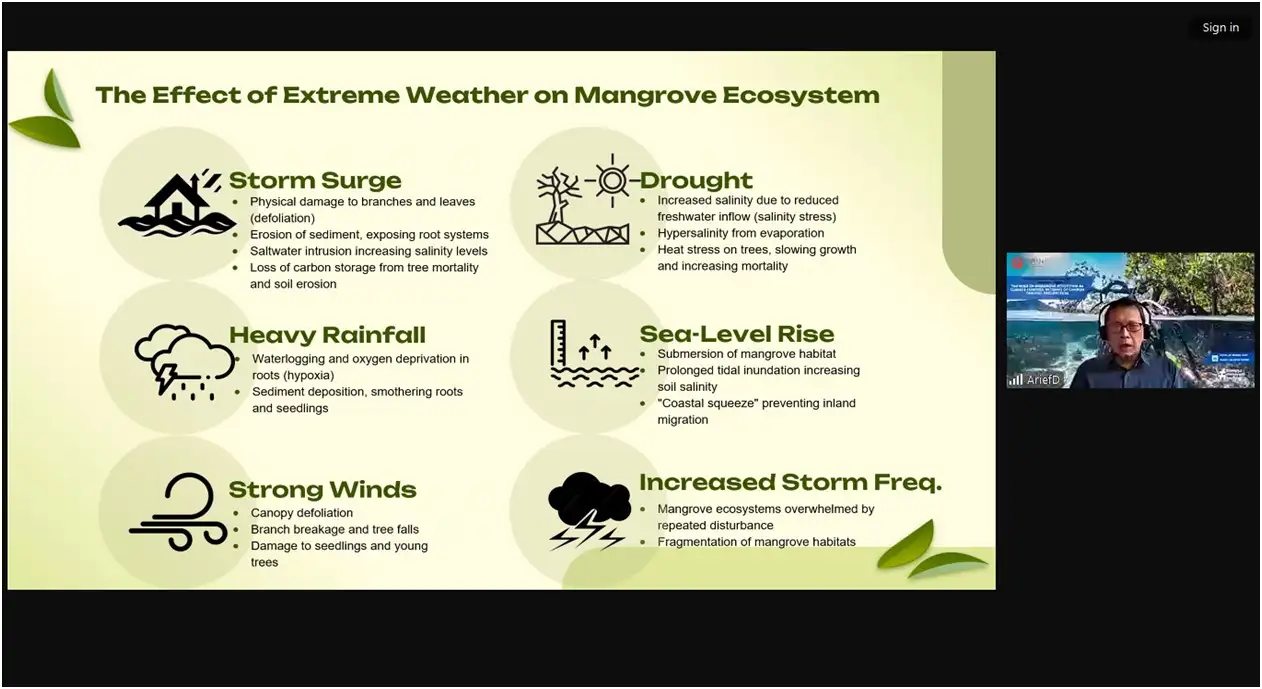
Arief again revealed that there are several possibilities that can threaten the mangrove ecosystem. Among them; an increase in the incidence of storms and rain to make mangroves lose oxygen and then become destroyed. For this reason, he suggested, before doing carbon trading, you should protect the ecosystem.
In the implementation, Arief added, mangrove rehabilitation and restoration programmes, replanting mangrove forests must be adjusted to the zone (habitat) of the mangrove species. The goal is that mangroves can live optimally. “It is important to know the type of mangrove that is suitable as a carbon trading asset. Indonesia has many opportunities and potentials in carbon trading, one of which is implementing Indonesia as the best carbon export centre,” concluded Arief.