News Detail
Through global collaboration, BRIN encourages efforts to utilise low plastic value in the construction industry
Jakarta - BRIN PR. The National Research and Innovation
Agency (BRIN) continues to seek innovative solutions to address environmental
issues, particularly related to waste management. This can be done by utilising
materials that were previously considered as waste, one of which is low plastic
value, to be used in the construction industry sector.
Low-value plastics is a term used to describe types of plastics that are less desirable, have low resale value or are difficult to recycle.
To discuss the latest innovations in managing low-value plastic waste for use in construction, BRIN's Research Centre for Sustainable Production Systems and Life Cycle Assessment (PRSPBPDH) in collaboration with JANGJO Indonesia supported by Institut Français Indonésie (IFI) - Ambassade de France en Indonésie, au Timor Oriental et Auprès de L'asean, held a workshop with the theme ‘The Next Big Thing in Sustainability: Low Value Plastic Waste in Construction’ on Thursday (3/10) at the B.J Habibie Building, Jakarta.
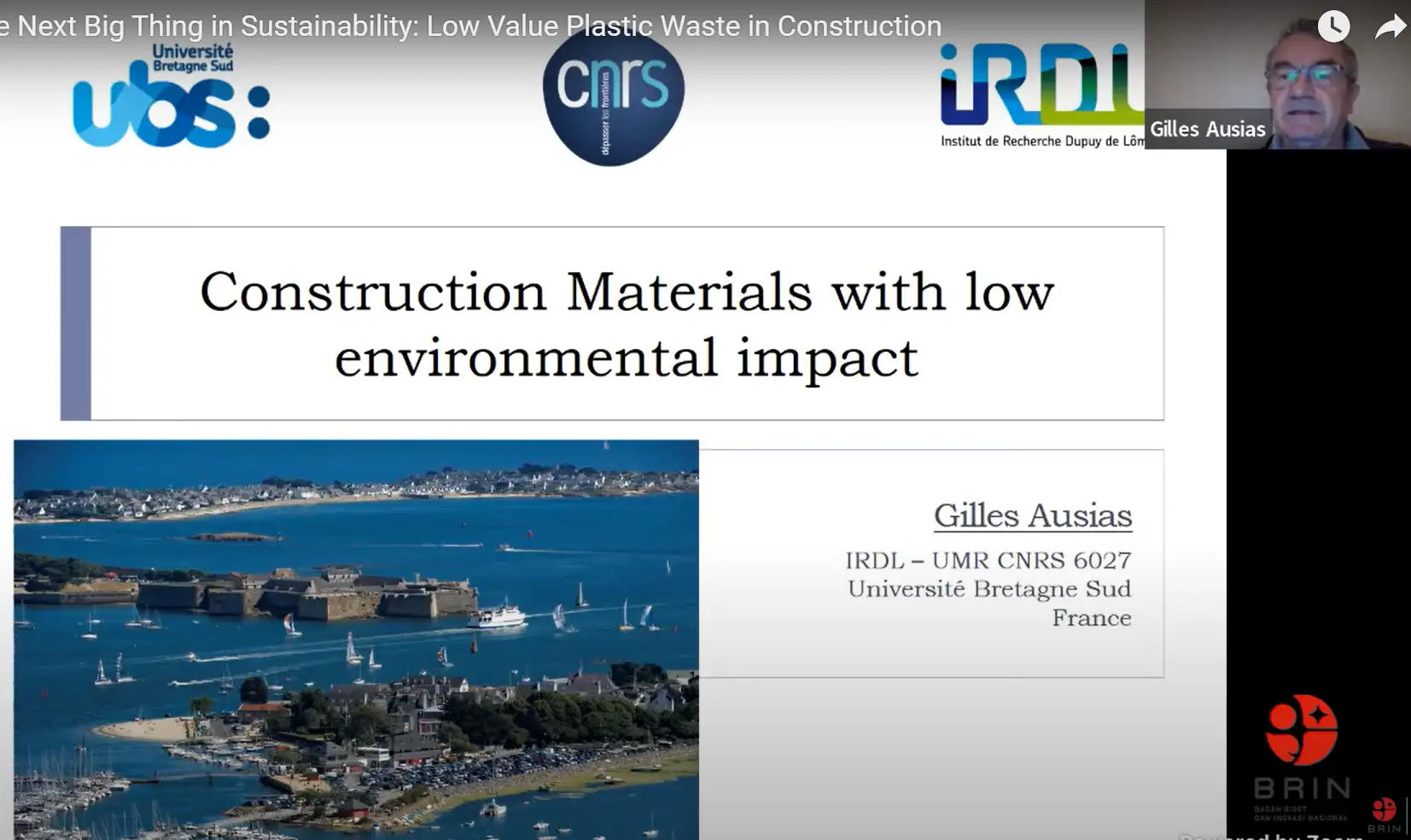
At the event, Professor of Mechanical Engineering at the Université Bretagne Sud, Ausias Gilles explained that low-value plastics have great potential to be used as environmentally friendly building materials. By combining it with natural fibres, plastic waste can be used to make various construction products, such as wood mixes, bricks, and insulators.
He then explained some of his research and innovations in managing plastic waste and finding alternative building materials that are more sustainable. Through a presentation titled ‘‘Construction Material with Low Environmental Impact’’, he explained how to develop environmentally friendly construction materials made from low content of cement, local materials and natural fibres.
Gilles explained the various benefits of 3D printing for construction, especially those using soil-based materials. ‘‘The benefits include providing safety, speed and reliability due to robot-based manufacturing, giving architectural freedom in terms of shape and design, providing solutions in terms of labour shortages and driving mechanical efficiency, including topology optimisation and biomimicry,’’ he explained.
He added that 3D printing can be used as an alternative to the production of environmentally friendly composite materials. By utilising the advantages of each technology, better, more efficient and sustainable products can be created.
Gilles and his team are also developing soil and straw-based insulation materials, one of which is applied in the form of building panels. They also collaborate with ETH Zurich and Columbia University to encourage the use of low-value plastics, focusing on recycling crushed waste paper into defibrillated cellulose fibres for use in building materials.
These collaborations have resulted in several exciting projects including the use of activated slag to stabilise soil, research into the manufacture of sediment-based bricks, the use of sediment as a complement in soil materials, and research into the transformation of invasive algae (ulva, sargassum) to stabilise soil-based materials.
He also analysed the properties of composite materials made from a mixture of lime and hemp fibre, which is one of the efforts to utilise natural and recycled materials in the construction industry.
Hemp concrete itself is a composite material made from hemp fibre and a binder made from a mixture of lime and water. ‘‘Hemp concrete is an attractive alternative building material due to its environmental friendliness and good thermal insulation. However, its low compressive strength and variation in natural material properties are challenges that need to be overcome for further development,’’ he added.
Gilles is also collaborating with Indonesian and French researchers to develop building materials that are more environmentally friendly. By using coconut fibre as reinforcement, research was conducted to obtain a cement composite material that has good mechanical properties and is more sustainable. This composite is a new material made by combining cement, water, sand, coconut fibre, and other additives.
Earlier in the event, Head of BRIN's Research Centre for Sustainable Production Systems and Life Cycle Assessment, Nugroho Adi Sasongko, said that this activity was an opportunity and potential for cooperation for participants consisting of researchers, industry and MSME business players, and policy makers to exchange ideas and share experiences to solve plastic problems in Indonesia.