IDEN
News Detail
BRIN Initiates Kratom Research for Diabetes Treatment
Published on September 22, 2024
Cibinong-BRIN Public Relations The National Research and Innovation Agency (BRIN) has initiated various studies on kratom, particularly its traditional uses and its pharmacological activities. From the research conducted, it was found that kratom exhibits two types of inflammation, namely in the alkaloids and extracts, which provide analgesic effects. Regarding safety and the potential for addiction, the WHO is still conducting research or reviewing the addictive properties of kratom.
"Currently, the testing process for kratom as a diabetes medication is being conducted with in vivo and in vitro tests. Empirically, data has also been obtained from several friends in Kalimantan who have a history of diabetes and consume kratom; it turns out that their glucose levels have decreased and their condition has improved compared to before consuming kratom," as explained by Masteria Yunovilsa Putra, Head of the Research Center for Vaccine and Drug at the National Research and Innovation Agency (BRIN), who revealed this in the BRIN Insight Every Friday (BRIEF) edition 133 with the theme Kratom: Traditional Uses vs Modern Applications, on Friday (20/09).
Kratom leaves are now a hot topic of discussion among the public due to claims about health benefits and controversies. Plants originating from Southeast Asia, including Indonesia, one of which is used for traditional medical purposes. Through the Ministry of Trade, the Indonesian government has officially regulated the handling, utilization, and trade of kratom as outlined in the Minister of Trade Regulation Number 20 of 2024.
"Kratom or mitragyna speciosa is an endemic plant in Southeast Asia, particularly in Malaysia and Indonesia, with most of its habitat in Kalimantan, and it can also be found in several areas in Thailand. Generally, kratom is exported to America and Europe," said Masteria.
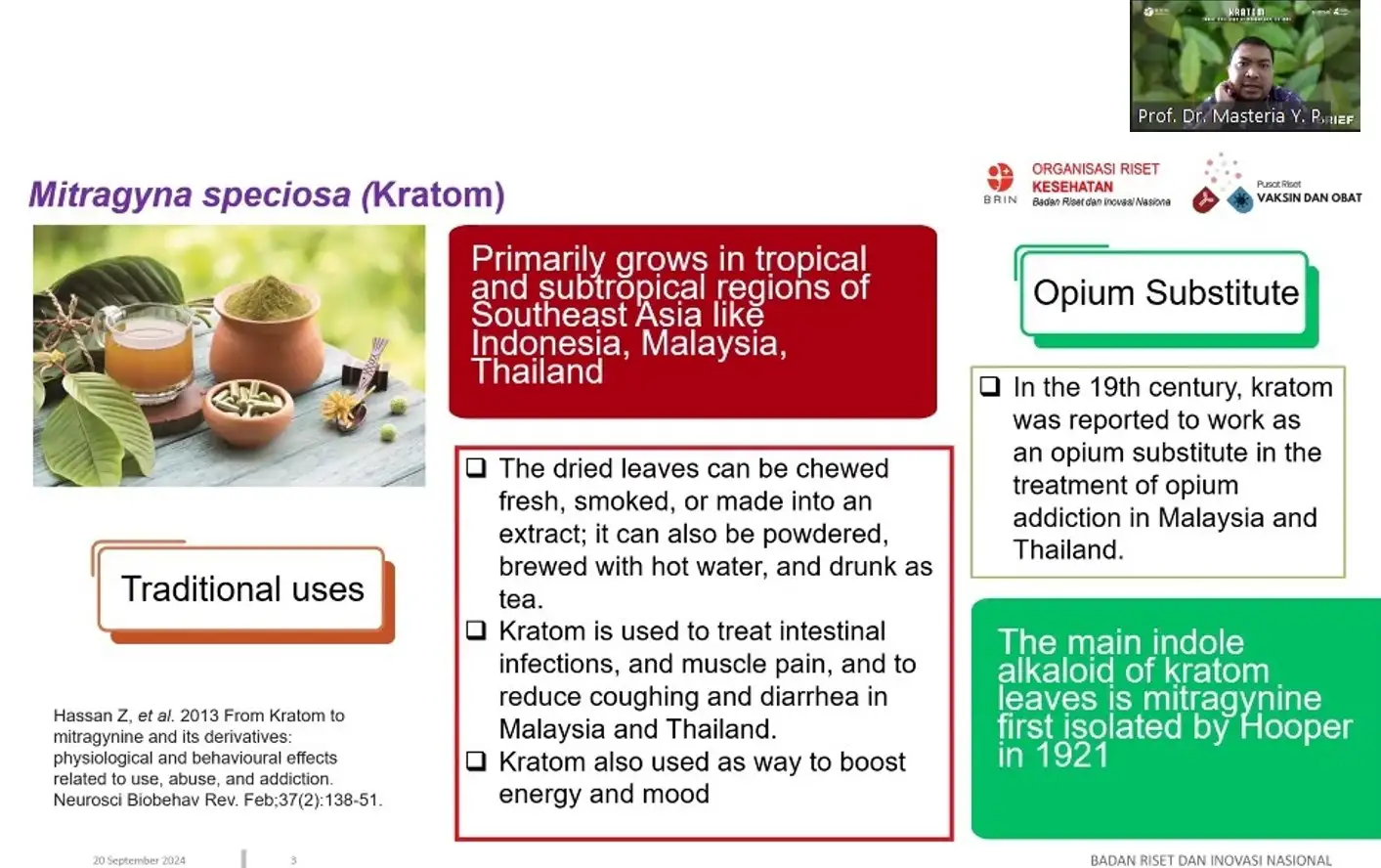
Kratom is a plant from the Rubiaceae family, which is related to coffee. Its local names include purik, ketum in West Kalimantan, and kedamba, kedemba in East Kalimantan. There are several types of leaves from this Kratom, namely Kratom with green and red vein leaves.
Masteria also explains that the traditional use of kratom involves consuming the dried leaves directly or brewing them with hot water and drinking it as tea. "Kratom is believed to be able to treat intestinal infections, muscle pain, cough, diarrhea, and can also boost energy and mood." "In the 19th century, in Malaysia and Thailand, opium addicts used kratom to cope with their addiction," he stated.
In 1921, the compound kratom was first isolated by Hooper, and research on it has been ongoing for 103 years, remaining controversial even to this day. In one of the papers of the Journal of The Chemical Society Transactions in 1921, it was mentioned that Ellen Field isolated the compounds mitragynine and mitraversine from Mitragyna speciosa. He mentioned that kratom is used for treating opium addiction and as a local anesthetic.
"There are at least 40 types of alkaloid compounds in kratom leaves, with 5 main compounds being mitragynine, paynantheine, speciogynine, 7-hydroxymitragynine, and speciocilatine, with compound content varying by region, ranging from 50 to 70%. The compounds most studied for their analgesic properties and addiction are Mytraginine and 7-hydroxymitragynine. These two compounds are also the primary focus for research into their potential as analgesics, anti-inflammatories, and for cancer," he elaborated.
In 2021, the WHO Expert Committee on Drug Dependence (ECDD) conducted a prereview of the health impact of kratom. They concluded that there was not enough evidence to proceed to the critical review stage, but surveillance by the WHO would continue.
"The kratom research conducted at the Research Center for Vaccine and Drug of BRIN so far includes the standardization of alkaloid extracts, in vitro studies consisting of antioxidant activity in cells, dual anti-inflammatory activity, and adjuvant for cancer therapy, as well as in vivo studies that include analgesic activity, withdrawal effects, and acute oral toxicity tests," he said.
According to him, kratom extract has antioxidant properties that can protect cells from free radicals such as reactive oxygen species (ROS) and nitric oxide. Kratom extract, in its crude form and alkaloids, exhibits anti-inflammatory activity through the potential inhibition of NSAID COX-2 and 5-LOX. With fewer side effects, it can be used as an adjunct therapy for cancer.
"The kratom extract has analgesic effects both in vitro and in vivo. Our in vivo studies show that at certain doses, the alkaloids in kratom have analgesic effects that are twice as high as those of the crude extract," as said by Masteria.
Masteria added that chronic administration of kratom alkaloids with increased doses induces fewer withdrawal symptoms compared to the morphine group. "Moreover, kratom alkaloids, when used to treat the morphine-treated group, tend to reduce withdrawal symptoms," as concluded by Masteria. (ash, lnw/ed.sl, ns/translator:akb)