News Detail
BRIN Develops High Quality Varieties for National Food Sustenance
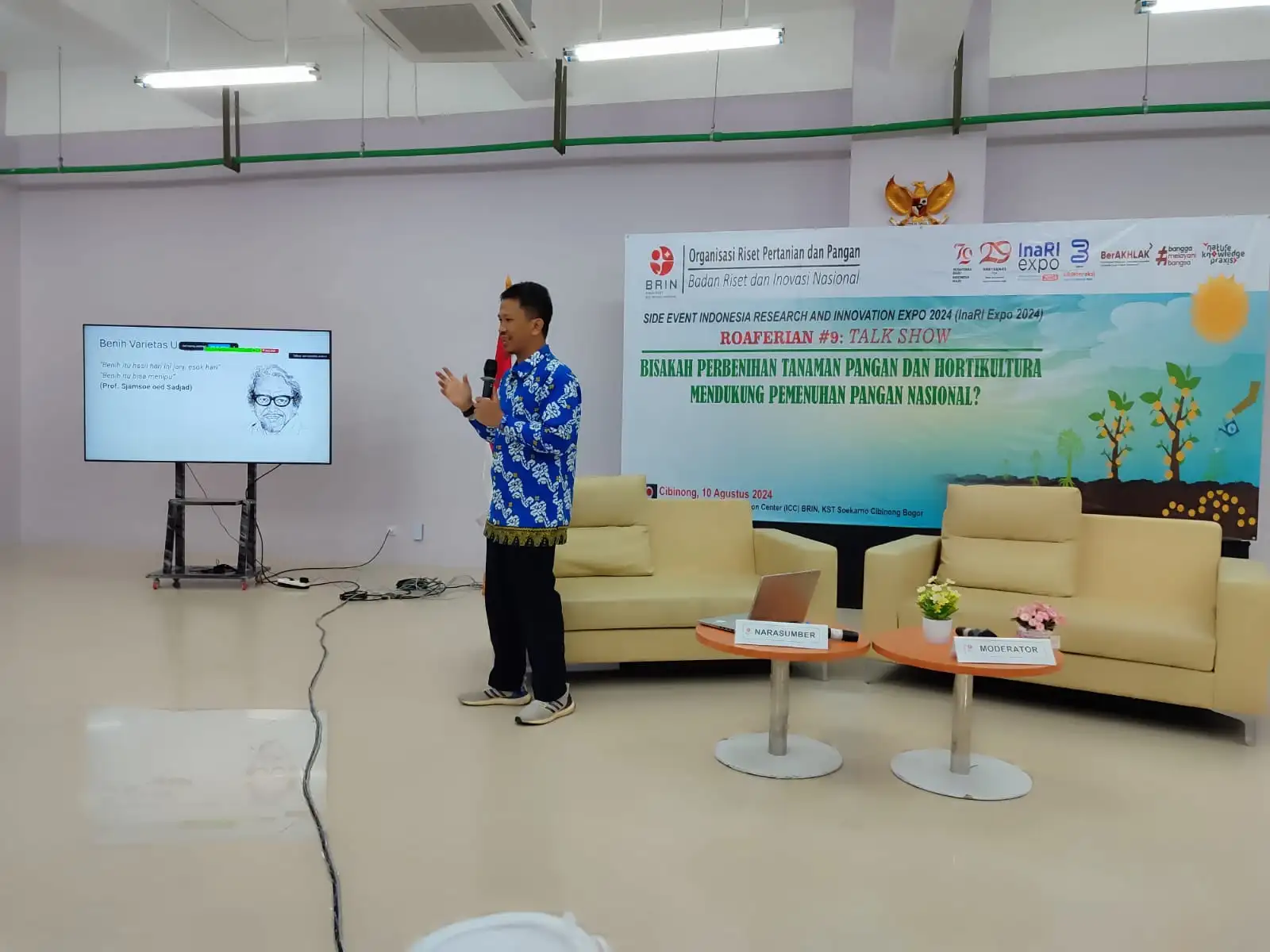
Cibinong-BRIN Public Relations. Head of the Food Crop Research Centre of the
National Research and Innovation Agency (BRIN) Yudhistira Nugraha presented
material entitled "Development of Superior Varieties and Best Practices in
Food Crop Seed Management".
He explained that production has increased in line with expectations, and the quality is good. However, seeds without the support of science and technology will not produce maximum benefits, including in the export of certain commodities.
This presentation was delivered at the ROAFERIAN Webinar #9 which was packaged in a Talk Show with the theme "Can Food Crop and Horticultural Seeds Support National Food Fulfilment?". Saturday (10/8). This event was part of the Indonesia Research and Innovation Expo (InaRI Expo) 2024, at the Soekarno Science and Technology Area, Cibinong, Bogor.
Yudhistira said that the current superior varieties are more productive than previous varieties. For example, the IR8 variety produced in 1968 can achieve yields of up to 9 tonnes per hectare. However, in 1998, the yield decreased to 6-7 tonnes, which was caused by climate change, especially high night temperatures. This increased plant respiration, reducing the photosynthetic output that should have been allocated to seeds.
"To overcome this problem, new high-yielding varieties need to be developed. Especially since plant resistance to pests and diseases, such as fungi or bacteria, can change rapidly. In addition, seed quality and consumer preferences also drive the need to replace superior varieties," he said.
In terms of research, rice productivity does show stagnation, with an average yield of 5 tonnes per hectare. However, research on rice crops conducted from 1967 to 2015 showed genetic progress in released rice varieties, with an increase in productivity of 0.7 tonnes per hectare per year, and an increase in genetic progress of 1.45 tonnes per hectare compared to 20 years ago. The challenge is how to plant these seeds so that their genetic potential can be maximised.
Yudhistira added that BRIN together with various stakeholders has produced various superior varieties of food crops, including 34 varieties of rice, 15 varieties of soybean, 2 varieties of mung bean, 1 variety of peanut, 3 varieties of sorghum, 1 variety of wheat, 1 variety of banana, and 1 variety of cotton.
"BRIN strengthens its research base with precision breeding through the integration of advanced technologies, genomic, transcriptomic, and metabolomic approaches, to fulfil public expectations," he explained.
The quality of superior varieties comes from rich genetic resources. BRIN makes maximum use of these genetic resources, including in assembling varieties that are resistant to various stress conditions, such as drought, flood, and salinity, and with phenotyping and molecular approaches.
In addition, BRIN is also developing varieties with the help of genome editing that will be released in 2025, to increase resistance to rice diseases as a preventive effort, so that production can increase.
At the end of his presentation, Yudhistira Nugraha hoped that the importance of BRIN's governance, from seed to production, as well as cooperation with private partners, related ministries and universities, ensures that superior varieties of source seeds can be accessed by partners.