News Detail
Ecopedagogy of Educational Solutions in Critical Environments
Jakarta - BRIN Public Relations. The issues of ecopedagogy,
natural schools, and adiwiyata schools are important, because they provide a
comprehensive framework for introducing the younger generation to the values of
sustainability. Syahrul Ramadhan, Chair of the Assessment and Learning Research
Group, Education Research Center (Pusrisdik) said that by involving the younger
generation in environmental conservation and encouraging behavioral changes,
towards a more sustainable lifestyle.
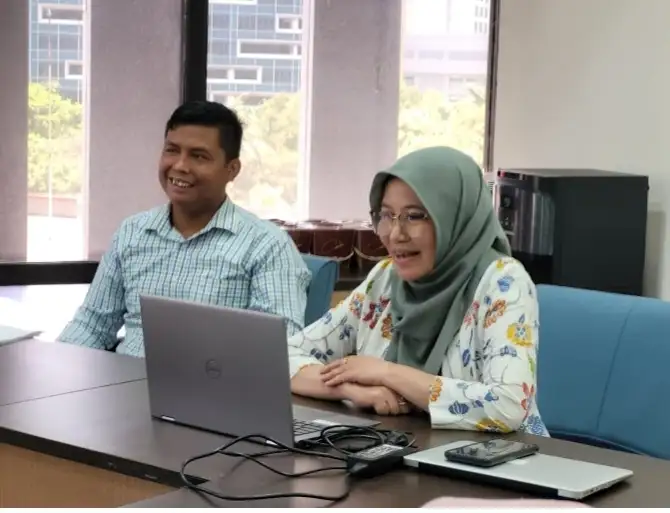
"This is very relevant considering the increasingly complex environmental challenges faced by Indonesia and the world as a whole," said Syahrul in the Sharing Session which took place on Wednesday (20/3) at the BRIN Sarwono Prawirohardjo Science Area Office, Gatot Subroto, Jakarta. On that occasion, Syahrul delivered the topic "Potential and Challenges of Ecopedagogy, Nature Schools and Adiwiyata Schools in Indonesia" which was the topic of discussion this time.
Trina Fizzanty, Head of Pusrisdik BRIN, said that this sharing session will be the first in 2024. "It is very important because we want to raise the issue that is most of concern to all countries regarding environmental aspects. "More importantly, how can this education contribute to providing stronger understanding and literacy to the next generation," continued Trina.
He then explained important things regarding environmental aspects, namely climate change which is now a concern and how the education sector can respond to help the younger generation understand it. So the discussion reviewed regarding the current aspects of pedagogy is sufficient to provide a stronger understanding of environmental aspects, including climate change, plastic waste and pollution. According to Trina, this issue is an important point regarding the ecopedagogical aspect of providing strong awareness about environmental conservation.
Berto Sitompul, an ecopedagogical practitioner and founder of the Teaching Waste Bank, delivered a presentation entitled "The Urgency of Ecopedagogy (Critical Environmental Education). He explained that within the Sustainable Development Goals (SDGs) framework, point 4 regarding the quality of education, namely the recontextualization of sustainable education, he showed the results of his research.
Berto explained that although most students understood the facts and stated that they cared about environmental issues, they did not connect these facts with their actions and behavior. This is because environmental education traditionally still focuses on nature education. Apart from that, environmental education is still mostly done in classrooms without being connected to environmental and social issues.
Next, he presented four ecopedagogical teaching systems. First, teaching about the social and natural environment, namely preparing texts related to the environment for children. With this, they are able to uncover current environmental issues, the roots of the issues, as well as strategies for responding to issues, both individually and collectively.
Second, teaching through the social and natural environment, namely leading students to awareness of their relationship with the environment, both social and natural. Third, teaching through the social and natural environment. Namely, adapting class assignments, writing exercises, group work, experiences, agreements with the community, to translate knowledge into social action, environmental justice, prosperity and sustainability. Fourth, teaching about the ongoing interconnectedness between creatures.
Then Berto said, in its implementation, ecopedagogy-based education needs to be developed based on comprehensive principles and approaches through holistic learning. This is ecopedagogical-based learning in the development of material which is not only limited to something textual in nature, but needs to be developed through a contextual approach.
According to him, learning must be oriented towards student activity and involvement in solving problems cooperatively and collaboratively. Furthermore, learning must be based on an interdisciplinary approach in order to comprehensively enrich students' knowledge and understanding.
He also said about the Teaching Waste Bank which has provided important education such as sustainable waste management. This is for the sake of a cleaner earth and prioritizes real practice rather than learning a lot of theory. This action was carried out together with school and community members who now number 10,000 students and educators in two provinces in 5 districts/cities in a total of 33 schools.
Lisadiyah Marifataini, Pusrisdik researcher, conveyed the exploration of educational research in natural schools by taking a closer look at the implementation of education in Indonesian natural schools. Lisa said, to explore education in natural schools, the first thing you need to know is the understanding and concept of natural schools. According to him, the implementation of natural schools is very unique and interesting to study, because it is different from the implementation of regular formal schools in general, both in terms of input, process and output.
Lisa then explained more about the implementation of the Indonesian Nature School in Depok. He explained by looking at different input aspects, namely the mindset (mainset) of students who generally want freedom in learning (independent learning). It also provides unique infrastructure, because the building is in the shape of a hut as a place for learning. The unique financing input also lies in the role of parents who are the main source of financing in fulfilling children's learning.
Furthermore, Lisa explained, in the process aspect, uniqueness can be seen from the implementation of learning which is carried out in the open air, carried out in class and outing class. The varied learning methods and egalitarian learning style will give students the freedom to develop their interests, talents and potential.
Meanwhile, in the output aspect, uniqueness can be seen in the graduates who are characterful, independent, have knowledge and skills in the fields of business and entrepreneurship. Also some are able to open business ventures and entrepreneurship. Others were accepted at various well-known universities both at home and abroad.
Meanwhile, Aldila Rahma, who is also a researcher at Pusrisdik, explained the title "Ecoliteracy, from Vision to Action: Collaboration of Tacit, Explicit and Empirical Knowledge to Realize a Sustainable Eco-School". According to him, ecoliteracy, which means environmental literacy, refers to the ability to understand humans' position in their environment. "Ecoliteracy aims to equip students with skills, attitudes and actions to be more protective of the environment," explained Aldila.
He then revealed that there are three paradigms that foster ecoliteracy, namely environmental education, where teacher to student transmission. "This environmental education is where the environment is a learning medium as well as environmental conservation," he explained.
Furthermore, he also explained about tacit knowledge, namely knowledge that exists in a person's mind according to their understanding and experience, so that it is unique and distinctive. Meanwhile, explicit knowledge is knowledge that is collected and translated in document form so that it is easy for other people to understand.