News Detail
BRIN develops 2045 Space Roadmap
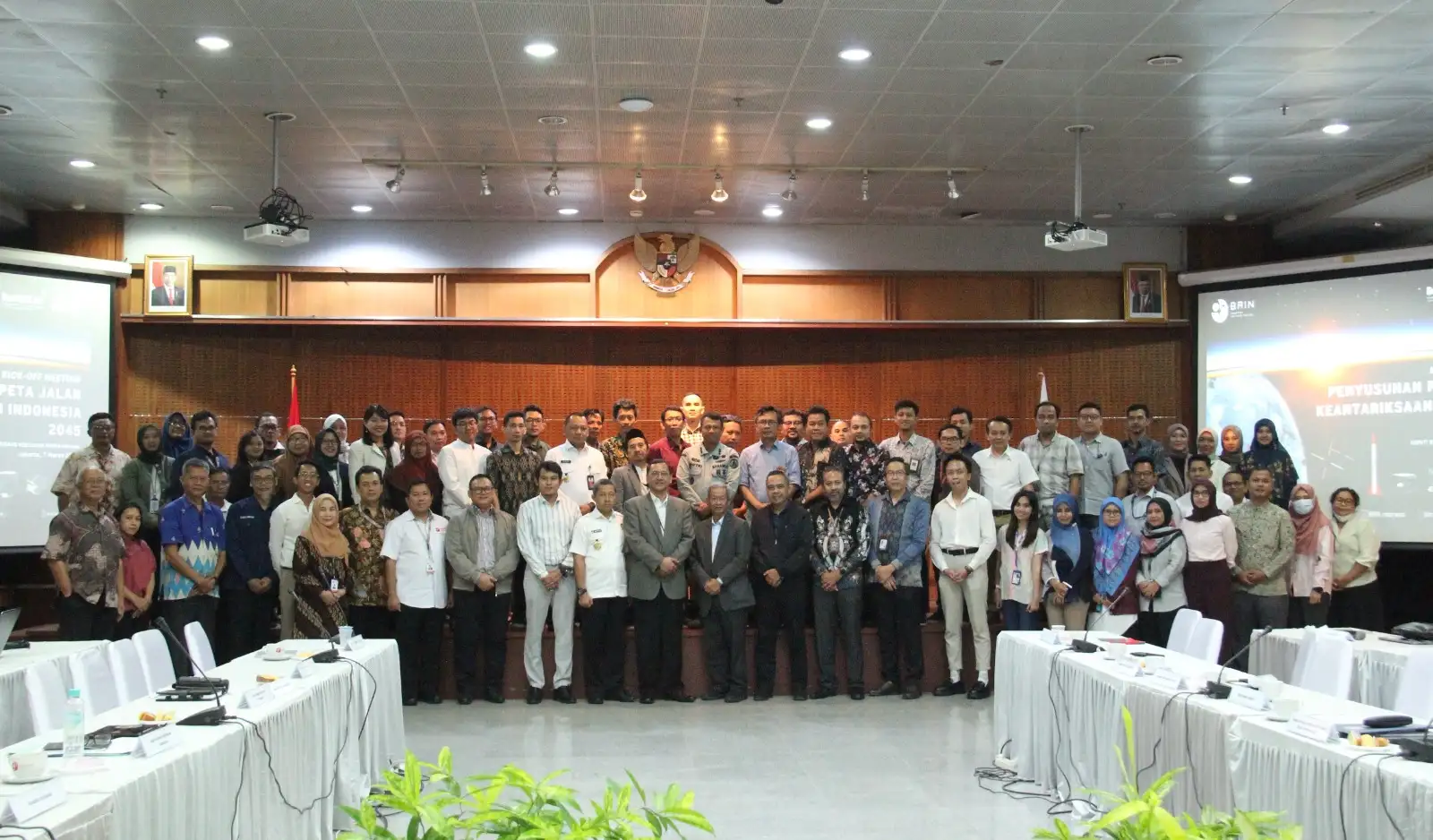
Jakarta - BRIN Public Relations. Head of the National Research and
Innovation Agency (BRIN), Laksana Tri Handoko said the preparation of
Indonesia's space roadmap until 2045 is very important. This is because it is
one of the mandates of Law Number 21 of 2013 concerning Space.
"BRIN is the main person in charge of almost all the mandates in the law. So it is certainly an obligation for us to hasten the making of a kind of space policy until 2045," Handoko said in his remarks when opening the "Kick off Meeting for the Preparation of Indonesia's Space Roadmap 2045" at the BRIN Office, Sarwono Prawirohardjo Science Area, Gatot Subroto Street, Jakarta, Thursday (7/3).
It should be noted, space activities have consistently supported various sectors in Indonesia such as agriculture, marine, fisheries, land monitoring, disaster, and so on. This is in line with the mandate of Article 2 of the Law (commonly called the Space Law / UUK), which is to optimise space for the welfare of the people and the productivity of the nation. However, the current policy direction only sees space as a support system, not as a specialised sector. Therefore, it is necessary to encourage the preparation of a relevant and implementable space roadmap by involving various parties at the national level.
In the event initiated by BRIN's Deputy for Development Policy, Handoko said that Indonesia is an equatorial country and also the largest user of satellite services, both for commercial purposes such as remote sensing satellites and so on. Currently, BRIN has initiated various space programmes, especially remote sensing, which will have a real economic impact on society and the country. "For this reason, the making of the space road map as well as the space policy until 2045 is very crucial, strategic and important for all of us," he said.
BRIN Deputy for Development Policy Mego Pinandito said that the meeting was to discuss several topics. Such as remote sensing programmes, satellites, aeronautics, space commercialisation, as well as rocketry and launch, space science, and other strategic issues.
He hopes that through this event various inputs can be obtained related to the views and needs of each sector, namely Ministries / Institutions (K / L), industry / associations, academics, and others. In addition, according to him, BRIN needs to see how the patterns or cooperation schemes that can be carried out by various sectors and strategic partners and others, which require information data support related to space. This is to realise a space roadmap that can be implemented. So that what we hope to realise is a space roadmap that covers all the needs of space.
In his presentation, Mego briefly discussed the preparation of the Indonesia 2045 space roadmap. Starting from the background, BRIN's achievements in the field of space, the 2016-2040 space master plan, the challenges faced, to the policies needed and strategies.
In the discussion session, several topics were discussed, including the development of a national remote sensing programme, the development of a national satellite programme, the development of an aeronautics programme, the development of a national commercial space programme, the development of a national launch programme, and the development of a space science programme. In the discussion, all sectors involved gave their views and inputs to design a suitable 2045 space roadmap.
Erna Sri Adiningsih as Executive Director of INASA conveyed several important points from this event. Starting from mapping the needs of remote sensing programmes, mapping the needs of satellite programmes, mapping the needs of aeronautics programmes, mapping the needs of rocketry and launch programmes, mapping the needs of space commercial programmes, and mapping the needs of space science programmes.
Furthermore, Erna also explained the space strategic environment, follow-up, and recommendations. One of the points in the follow-up is that the road map needs to be prepared to accelerate the achievement of the space road map. Some of the recommendation points include first, that there is a need to accelerate the space road map. Second, remote sensing targets need to be accelerated in 5 years. Third, access to space is a long-term target. Fourth, there is a need for private/industry involvement in space activities in various space segments. Fifth, strategies are needed to achieve long-term targets, but can meet urgent needs in the short term. Sixth, the ultimate goal of space policy is to create a space ecosystem that allows the creation of a clear market, supporting regulations, technology development for breakthrough, availability of funding systems, and so on.
Erna added that another important thing related to strengthening Indonesian space is through space diplomacy strategy. The role of space diplomacy also needs to involve various stakeholders such as government, academia, private sector by building integrated, comprehensive and multi-stakeholder partnerships. This is done in order to gain support from the global community to advance space in Indonesia.
At the end of the event, Mego expressed his appreciation to all parties involved in this event. He hopes that after this Kick off event, communication with various related parties can continue to be established in order to add things that need to be added in the preparation of the 2045 space road map.