News Detail
Indonesia has 30,000 plant species and marine resources for herbal medicine
Cibinong-BRIN Public Relations. Indonesia is a country rich
in flora and fauna and has approximately 30 thousand species of plants and
marine resources, which have the potential to treat diseases in animals and
humans. Some plants can have potential as herbal medicines that are widely used
in animals in preventing and curing diseases. This was revealed by NLP Indi
Dharmayanti, Head of the Health Research Organisation of the National Research
and Innovation Agency (BRIN), during a webinar on the topic of Veterinary
Medicine Research and Innovation, Tuesday (30/01).
"Technological advances in the field of veterinary medicine have found many new types of veterinary drugs from vaccines, the use of sera therapy, anti-viral, anti-parasitic, anti-fungal, anti-bacterial, and diagnostic materials for animal diseases. To further improve the health and production of livestock and fisheries, it is necessary to provide adequate veterinary drugs, both in terms of quantity and quality in the manufacture, supply, and circulation," he said.
Harimurti Nuradji, Head of BRIN's Veterinary Research Centre, said that infectious and non-infectious diseases tend to increase, both in animals and humans. Controlling animal diseases is needed through research and innovation, one of which is to prevent, handle, diagnose, and treat diseases.
"The Veterinary Research Centre conducts research and innovation on all animal commodities ranging from livestock, pets, wild animals, aquatic animals, animal product vectors and related to the environment. One of them is research and innovation in the development of veterinary drugs that can be used in disease control," he explained.
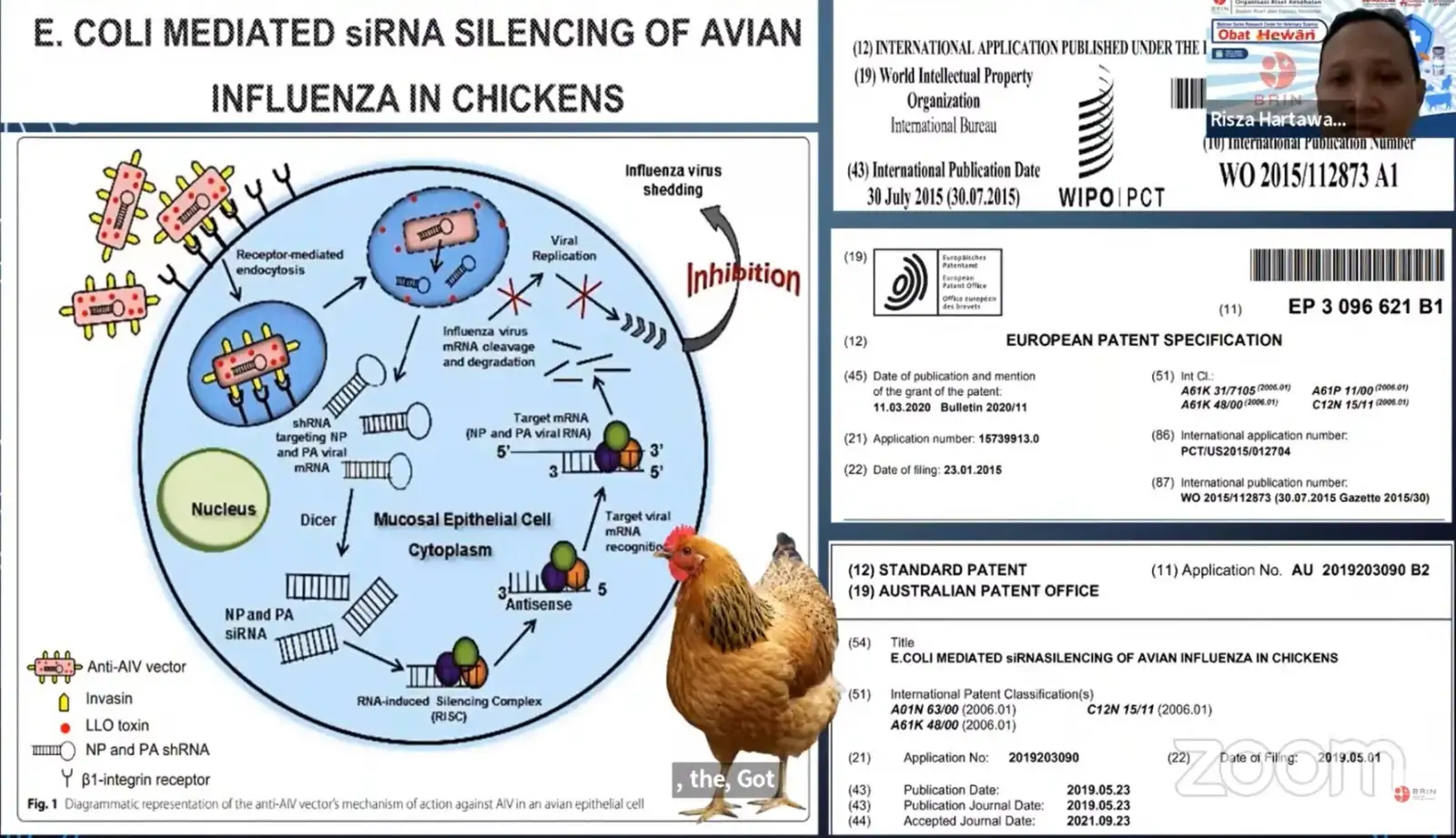
Risza Hartawan, Researcher at the BRIN Veterinary Research Centre, in his presentation explained about the Development of Alternative Antivital based on small interfering (siRNA) for Influenza Virus. Small interfering is a short-chain RNA sequence with a size of 19-21 nucleotide, not expressed into protein. It has gene silencing properties, can degrade complementary mRNA, and can be made synthetically with various modifications.
Various kinds of siRNA have been developed for several viral diseases such as ebola virus, HIV, influenza and nipah virus in silico. Most of the siRNAs used were not able to fulfil the whole range of viruses except siRNA-NP1089 and siRNA-1496.
Meanwhile, Fitrine Ekawasti, a researcher from the BRIN Veterinary Research Centre, presented her research on the Activity of Nanopowder Zingiber officinale var, Rubrum (Red Ginger) and Curcuma longa (turmeric) as Anti-Toxoplasma.
According to her, toxoplasmosis is a zoonotic disease that is dangerous for animals and humans because it causes disturbances in reproduction and growth. Toxoplasma gondii enters the body and evades the immune system, forming parasitophorous vacuoles that are difficult for the immune system to recognise.
"Several anti-toxoplasma studies have been conducted by developing natural medicinal ingredients that are non-toxic and contain high antioxidants, including red ginger and turmeric. In this study, a combination of red ginger and turmeric was carried out through the development of nano particle formulations, in the form of nanopowder to be more optimal and effective," she explained.
The next speaker, Tuti Sumiati, explained about Koi Herpesvirus Disease and its Control Efforts in Carp and Koi (Cyprinus Carpio). Koi herpesvirus disease (KHV) is highly contagious with high mortality (80-100%) that is specific to Cyprinus carpio.
"Efforts to control Koi Herpes Virus that have been made include knowing the trigger factors for the onset of KHV disease, ecological characteristics, and control strategy options. While eco-biotherapy of KHV disease in carp/koi with herbal therapy, immunostimulants, artificial infection to induce specific immunity," Tuti explained.
Preventive efforts by giving immunostimulant vitamin C 1 g/4kg feed, every 3 days can increase the body's defences. Overcoming stress, increasing appetite, fulfilling the need for vitamin C. Meanwhile, giving meniran 10g/kg feed, once a day can increase the body's defences and suppress excessive immune system reactions.
"While control through vaccination by immersing the inactive KHV virus, a dose of 1 mL/L vaccine for 30 minutes in aerated conditions, there are no significant results so further research is needed. Koi Herpes Virus control strategies can also be through avoiding stress in fish, anticipating/manipulating water temperature, increasing stamina, and good cultivation management," he explained.
Finally, a resource person from BRIN's Veterinary Research Centre, Dwi Endrawati, explained the potential activity of propolis as an anti-dermatomycosis agent. Propolis with its active substance content can be used as an anti-fungal. "The results of the in vitro anti-fungal test of propolis showed lower activity, compared to the results of the in vivo test. This is due to the anti-inflammatory effect of propolis that works on the skin to accelerate wound healing," he said.
Dwi suggested that further research is needed regarding the possibility of propolis active substance content that can cause side effects (contraindications) as an anti-fungal. Further studies are needed to challenge the genus of dermatophyta, candida, and malassezia that are antifungal resistant to propolis.
5. BRIN Chairman Presents Priority Topics in the Research Collaboration Platform
Jakarta - BRIN PR. The Chairman of the National Research and Innovation Agency (BRIN), Laksana Tri Handoko, revealed some specific topics that BRIN prioritises in 2024 research and innovation funding. He mentioned that certain topics that are included in the national priorities will be included in the collaboration platform.
"We have a structural biology collaboration platform, for example, to strengthen food, because we want to utilise the biodiversity in Indonesia more massively, so we are creating a collaboration platform so that later we can have, for example, far more new varieties," Handoko said when interviewed after the Launching of the 2024 Research and Innovation Funding, at the BJ Habibie Building, Jakarta, Tuesday (6/2).
Furthermore, Handoko highlighted other priority areas such as expeditions aimed at exploring seismic potential and earthquake sources, including marine expeditions to study the potential for tsunamis along the coast of Java. In particular, expeditions that focus on earth aspects are directed to Java Island, including Mount Merapi, to address disaster preparedness.
"So other priorities include disaster. We also have expeditions to look at potential faults and earthquake sources, as well as marine expeditions to look at potential tsunami sources," he said.
In response to a question about research outside Java and Sumatra, which has received less attention, Handoko explained the establishment of Research Collaboration Centres, which are different from the usual Centres of Excellence (PUI). These centres aim to foster cooperation between various research institutions, including universities and research institutes, with research centres already established in several regions such as Pattimura University in Ambon and Andalas University in Sumatra.
Handoko underlined the importance of collaboration between academia and industry, noting that while most of Indonesia's research resources are concentrated in universities, engagement with industry partners remains crucial to fostering a robust research ecosystem. With a sizeable number of researchers in universities, which can reach hundreds of thousands, he emphasised the importance of expanding research opportunities to other sectors, including industry.
The general objective of BRIN's facilitation programme, according to Tri Handoko, is to strengthen the research and innovation ecosystem so as to increase the quantity and quality of research outputs. Through strategic collaboration and prioritisation of specific research areas, BRIN aims to ensure that research conducted in Indonesia is not only abundant but also impactful and aligned with national interests.