News Detail
Research Contribution Lowers Stunting Prevalence Rate
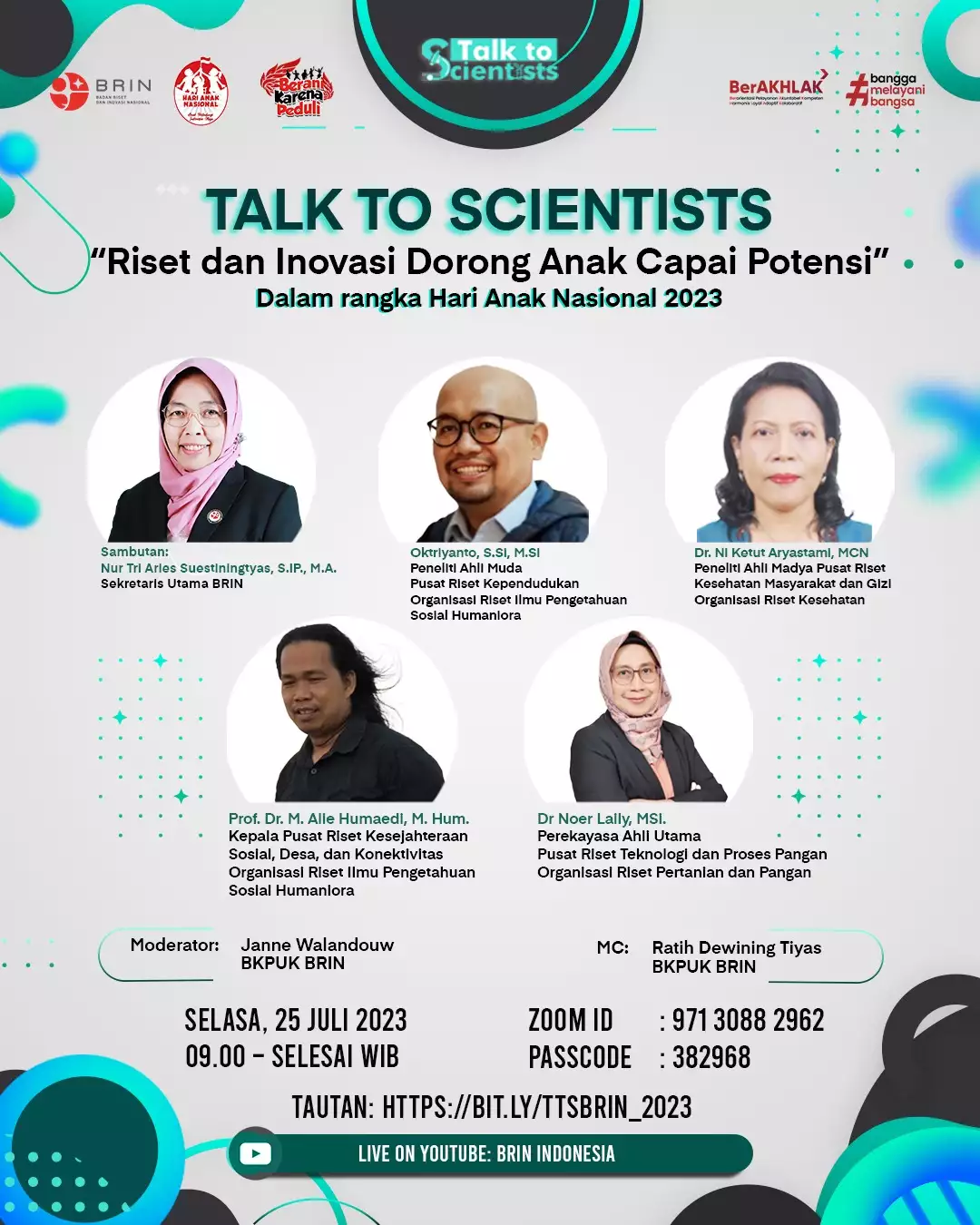
Jakarta - BRIN Public Relations. National Children's Day, which is celebrated on July 23, is an important momentum to remind all parties about the important role of children in national development. These children will later become the nation's next generation to realize Golden Indonesia 2045. The National Research and Innovation Agency (BRIN) pays high attention to the quality of the young generation, in this case, Indonesian children. Through a research program for young talents, it is hoped that Indonesian children will be able to compete in the field of science and technology. In commemoration of National Children's Day, BRIN held a Talk to Scientists webinar entitled Research and Innovation to Encourage Children to Reach Their Potential on Tuesday, (25/07) via the link https://bit.ly/ttsbrin_2023
Coinciding with the commemoration of the 39th National Children's Day, all parties are reminded that the problem of child development is a serious concern for the government, especially regarding stunting. Based on the results of a survey by the Ministry of Health, it is stated that the prevalence of stunting in Indonesia has decreased from 24.4% in 2021 to 21.6% in 2022. The government continues to try to reduce this prevalence rate by targeting a reduction of up to 14% in 2024.
Stunting, or often referred to as growth failure, is a serious public health problem in Indonesia. This term refers to the condition when a child has a lower height than the standard for his age. Stunting occurs in children due to chronic and prolonged malnutrition during their growth years.
Ni Ketut Aryastami, Associate Researcher at the Public Health and Nutrition Research Center - Health Research Organization, National Research and Innovation Agency (BRIN), said that reducing the prevalence of stunting is part of the government's strategic plan. "The problem of high stunting in Indonesia has been the government's concern since 2010, when the government has committed itself at the global level to the Scaling Up Nutrition Movement," said Ni Ketut.
In an effort to realize the target of reducing the prevalence of stunting, said Ni Ketut, the government has involved various related sectors, not only the government, but academia, the business world, and the community. The government's target of accelerating the reduction of stunting towards the golden generation of 2045 is considered quite ambitious, namely 14% in 2024.
"Of course we shouldn't be skeptical about this ambition, but what needs to be realized is the knowledge of the community, including stakeholders, regarding the fundamental problem of stunting, which is not just an achievement of program indicators," continued Ni Ketut.
Ni Ketut said that the cause of stunting is multifactorial, not only due to sub-optimal nutritional intake and co-morbidities, but also due to poverty, environmental health, including the availability of clean water.
Noer Laily, Main Expert Engineer at the Food Technology and Process Research Center, Agricultural and Food Research Organization, said that nutritional deficiencies such as zinc, iron, iodine, calcium, and folic acid in children under five can cause growth disorders, intellectual disorders, increased morbidity, and mortality. This is caused by insufficient food intake, namely the lack of intake of foods derived from animal foods and the low bioavailability of minerals.
"Micronutrient deficiencies can be prevented by consuming a variety of foods rich in micronutrients and increasing the bioavailability of micronutrients through proper food processing," said Laily.
As Laily explained, many studies have been carried out as strategies and efforts to prevent long-term and sustainable micronutrient deficiencies, through the modification of local food in an effort to increase the bioavailability of micronutrients and formulate them into food products. Various research results show that fermentation technology, germination, and processing using enzymes can increase the bioavailability of nutrients.
"The formulation of food products using foods of animal origin can increase the availability of vitamin A, iron, zinc, and vitamins B2, B12, and B6," he continued.
Processing food products through food fortification techniques into other foods (staple foods) according to Laily, is one of the solutions to adding or increasing certain nutrients to staple foods. For example, the processing of fortified corn with spinach, potatoes with cowpea, and sorghum with yam beans has been shown to increase the content of magnesium, phosphorus, zinc, potassium, iron, increase fiber and protein.
Young Expert Researcher at the Population Research Center - Humanities Social Science Research Organization Oktriyanto, said that the most important thing to pay attention to in solving the stunting problem is the first 1000 Days of Life (HPK). This period is the most important part of human life.
"The 1000 HPK period, which is 270 days during pregnancy and 730 days in the baby's first life after birth, is a sensitive period because the consequences for the baby during this period will be permanent and cannot be corrected," said Oktriyanto.
He explained, the impact was not only on physical growth, but also on mental and intelligence development, which in adulthood can be seen from the physical size that is not optimal and the quality of work that is not competitive, which results in low productivity. Overall, it can reduce the quality of Human Resources (HR) and the nation's competitiveness in the future.
"Adequacy of nutrition at 1,000 HPK, or from the time a child is in the womb (9 months) until he is 2 years old, is often referred to as the golden age. This means that since before pregnancy, expectant mothers must meet the nutritional needs of the fetus they will contain," continued Oktriyanto.
Principal Secretary of the National Research and Innovation Agency (BRIN) Nur Tri Aries Suestiningtya said BRIN pays full attention to the quality of the younger generation. This is in line with the appointment of BRIN as the coordinator for research and innovation in the national talent management task force.
"Through research programs for young talents, we hope that Indonesian children will be able to compete in the field of science and technology. And we are also trying to optimize research and technology to oversee children's growth in welcoming the golden generation in 2045," said Nur Tri Aries.
Through the momentum of commemorating National Children's Day this time, we invite all parties to celebrate the intelligence, creativity and unlimited potential that our children have. National Children's Day is an important thing to remind about the important role of children in nation building.
"Apart from that, we also feel the need to promote research and innovation as a means of encouraging our children to achieve their best potential," concluded Nur Tri Aries.